Day 10: Getting Into the Rhythm (13 March 2019)

When I was a boy, my mother always reminded me that I should never be late for dinner. You must be home at 5 exactly, she said.

I knew that she was serious but didn’t realize how it generalized. My friend Neil and his wife were visiting LA back in the 90’s. My mother said that dinner will be served at 5. Neil said that they could not make it until 5:45. Five, my mother said. When Neil and Joyce arrived at my parents’ home at 5:45, dinner was over and plates were being cleared. I often wondered where this obsession with time came from.

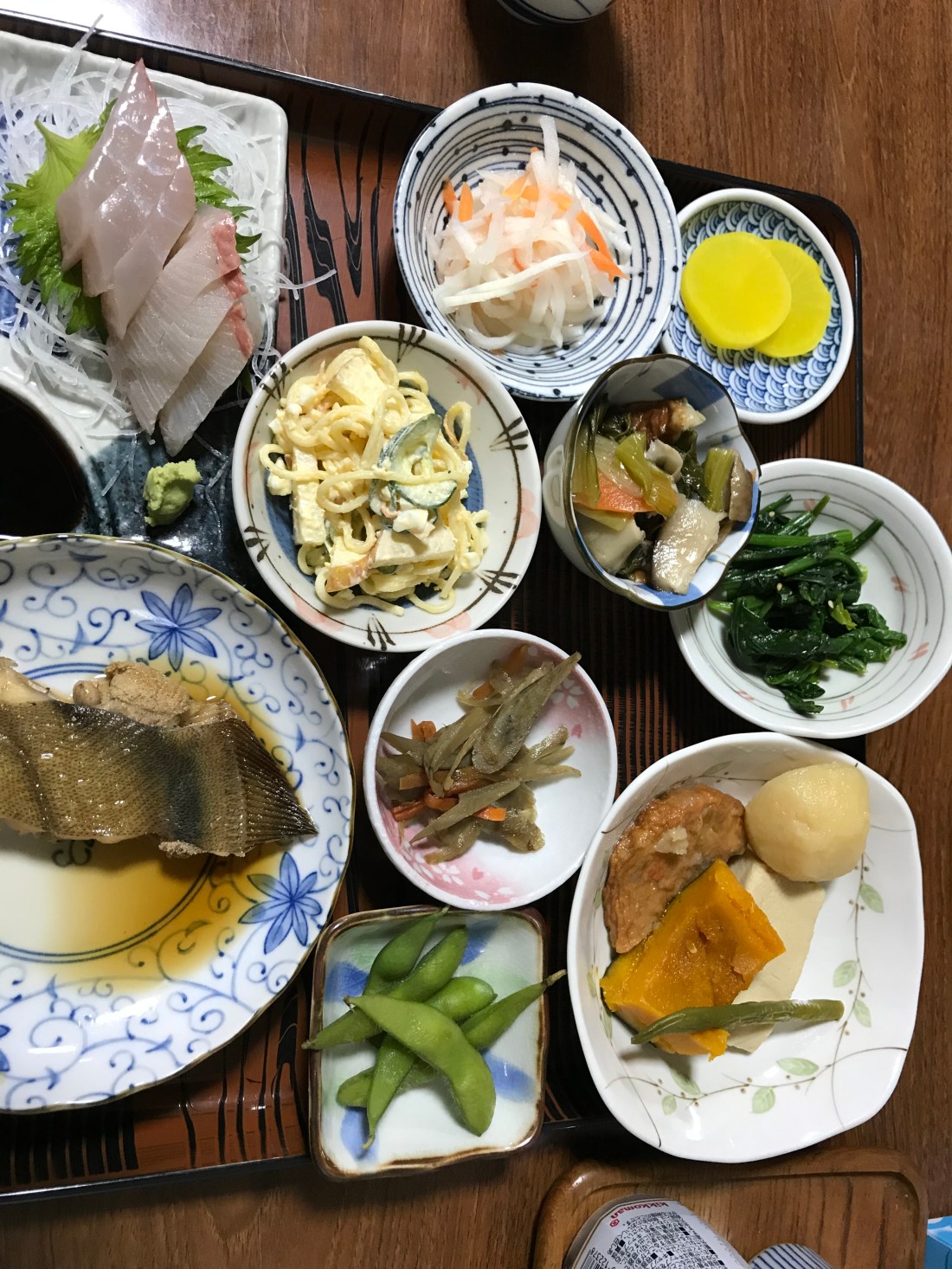
For the past 7 days living in Japanese inns, I get it. Breakfast is at 6 AM, not 6:02. At one ryokan, I came into the dining room at 6:02. Everyone was seated with their breakfast trays in front of them. I was told that breakfast was “around” 6. In Japan, as far as time, there are no “arounds.”

The same is true when you arrive at your accommodations (except for hotels). Dinner is no later than 6 and you better have had your bath beforehand. Lights out at the inn at nine except in your room.

These times are pretty functional if you want to complete 12-18 miles of walking in a day. One has to be on the road by 7, no later than 7:30, if you want to have your bath and be on time for dinner.

It had taken me several days to get into the rhythm. After experiencing how long it takes to walk 18 miles, I have become mindful of the time that I need to start in order to make bath and dinner time.

Today, I set out from my inn at 7:30. I had planned a 12 mile walk that turned into 18 miles. I am not sure whether my book of maps is inaccurate or I just can’t count.

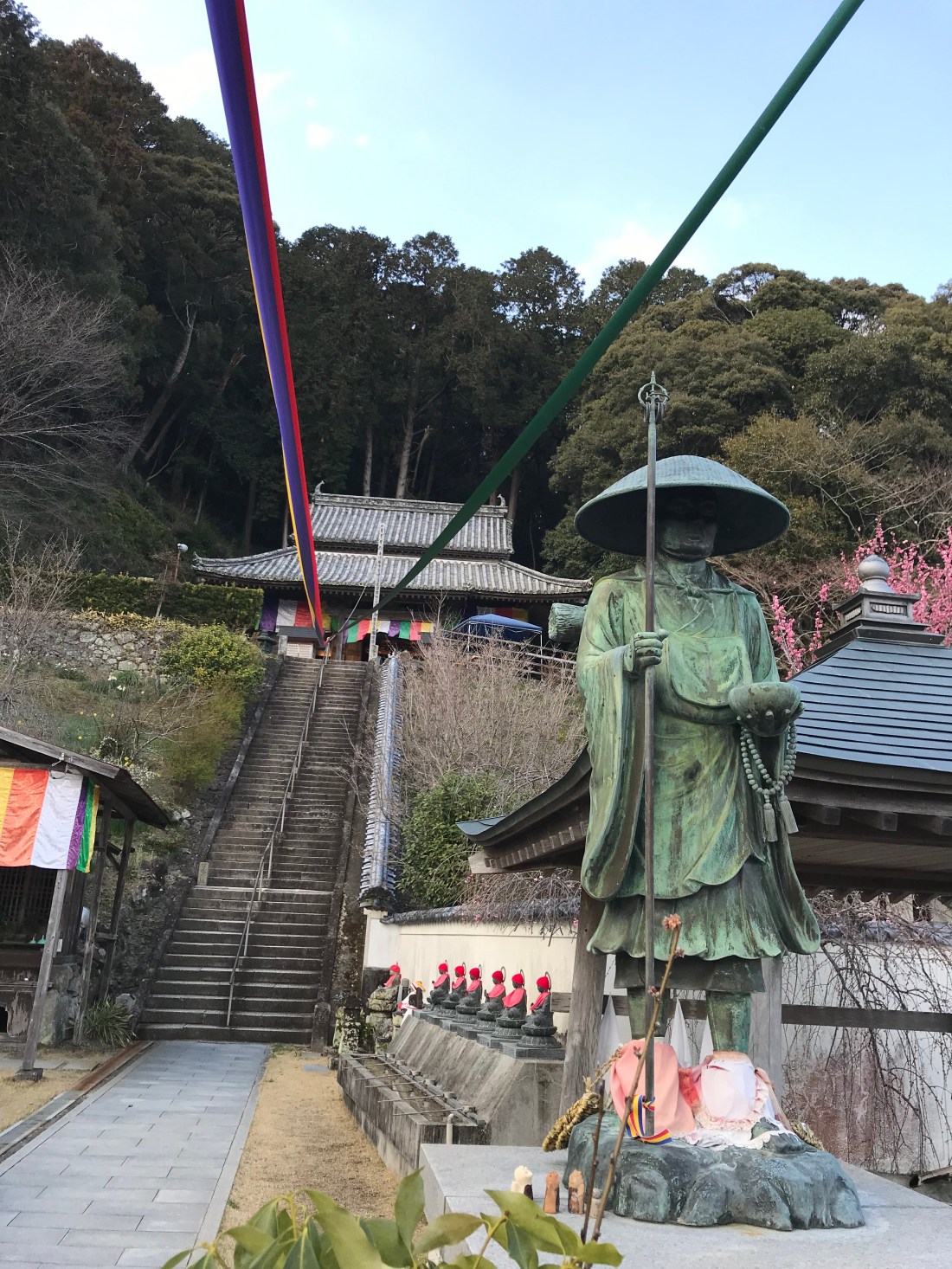
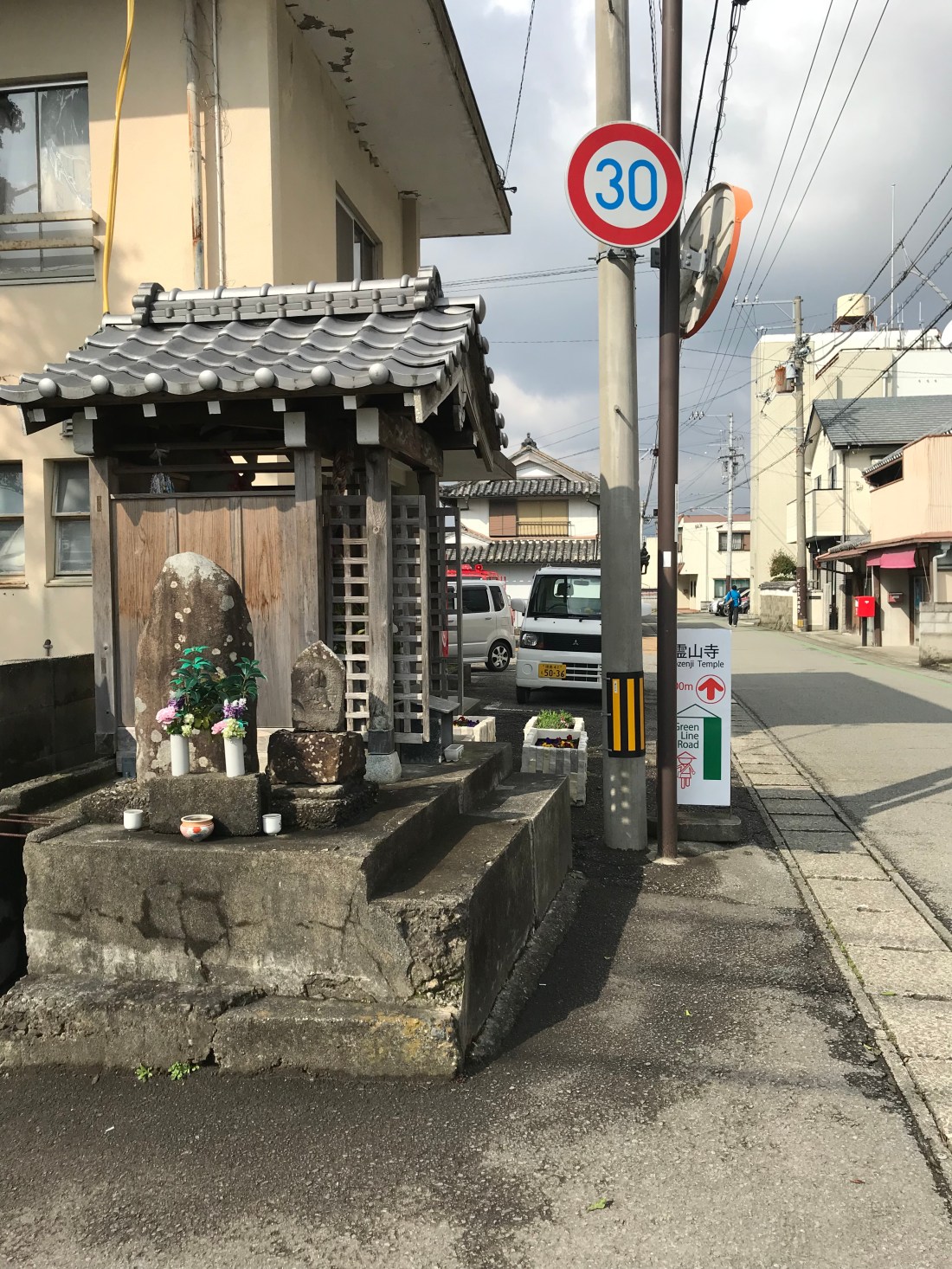
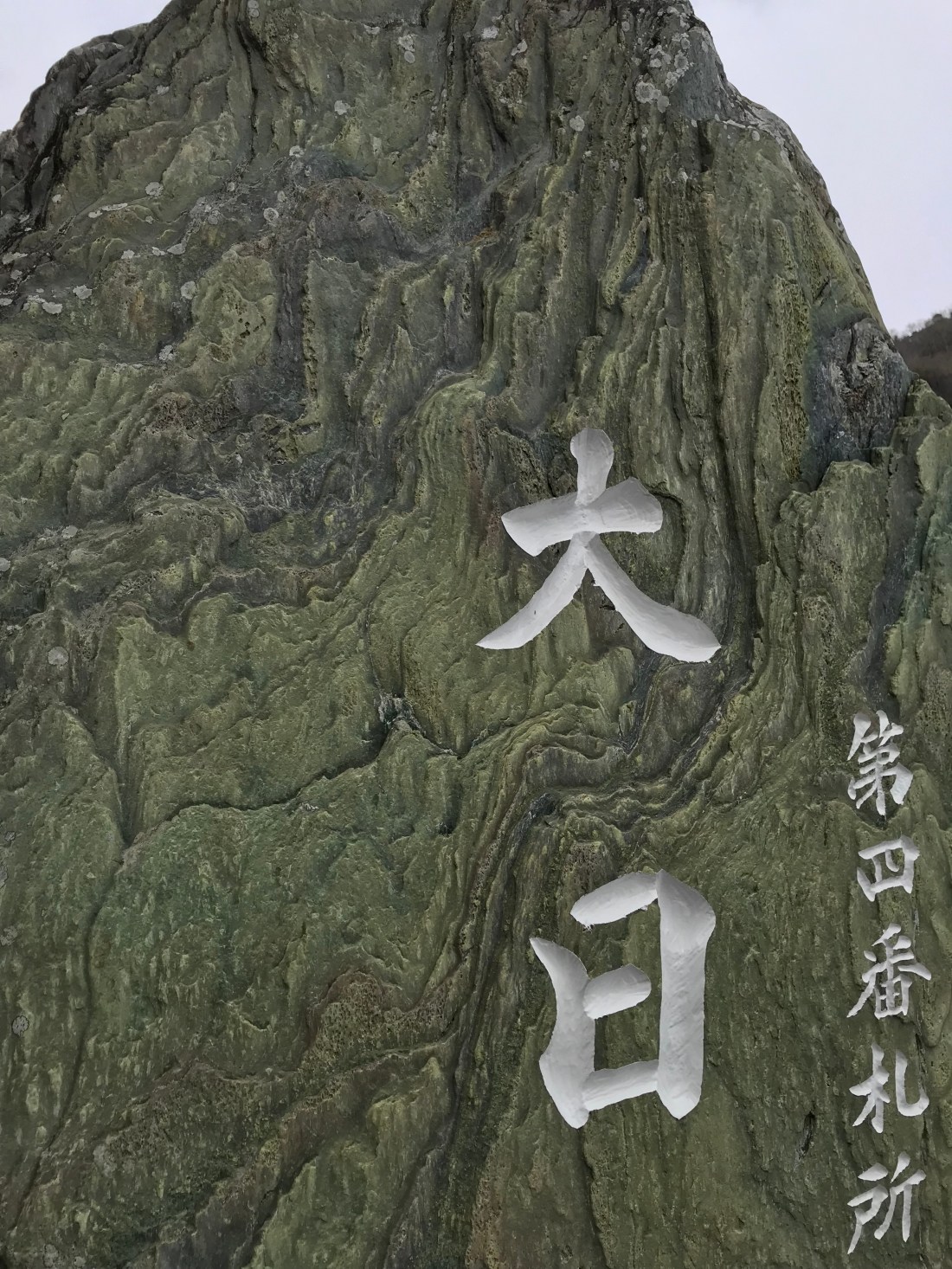
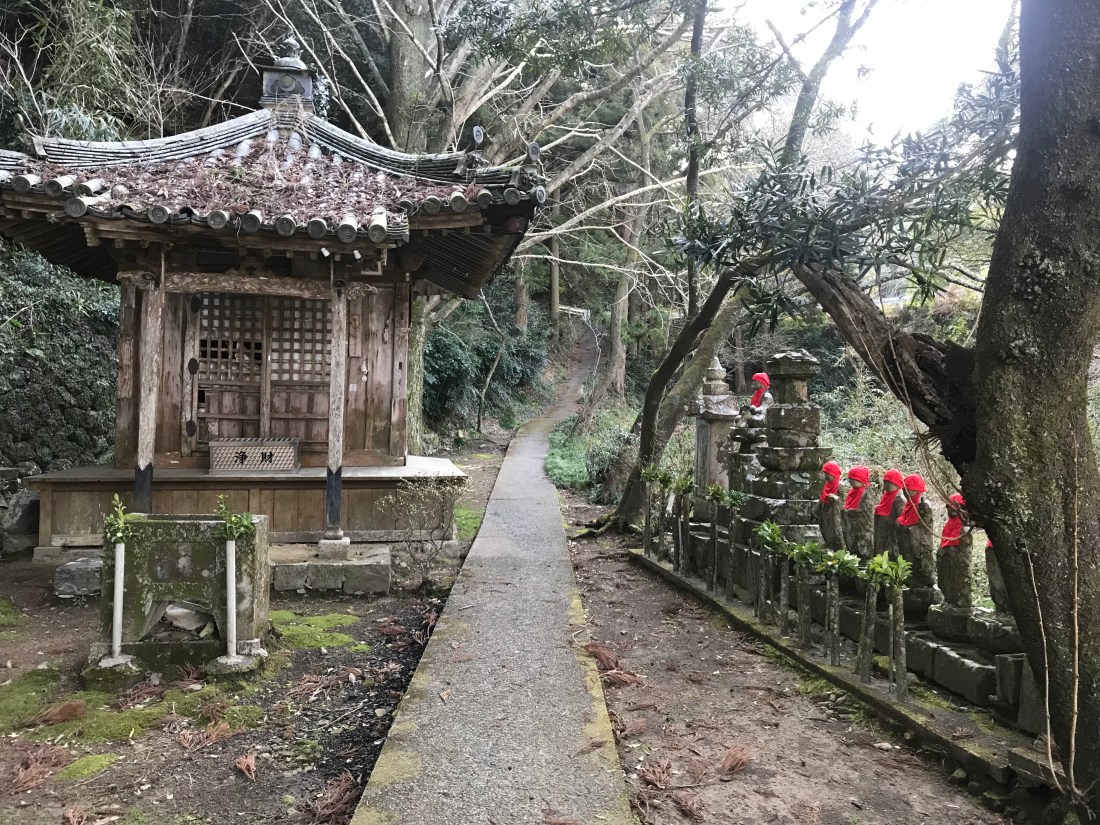
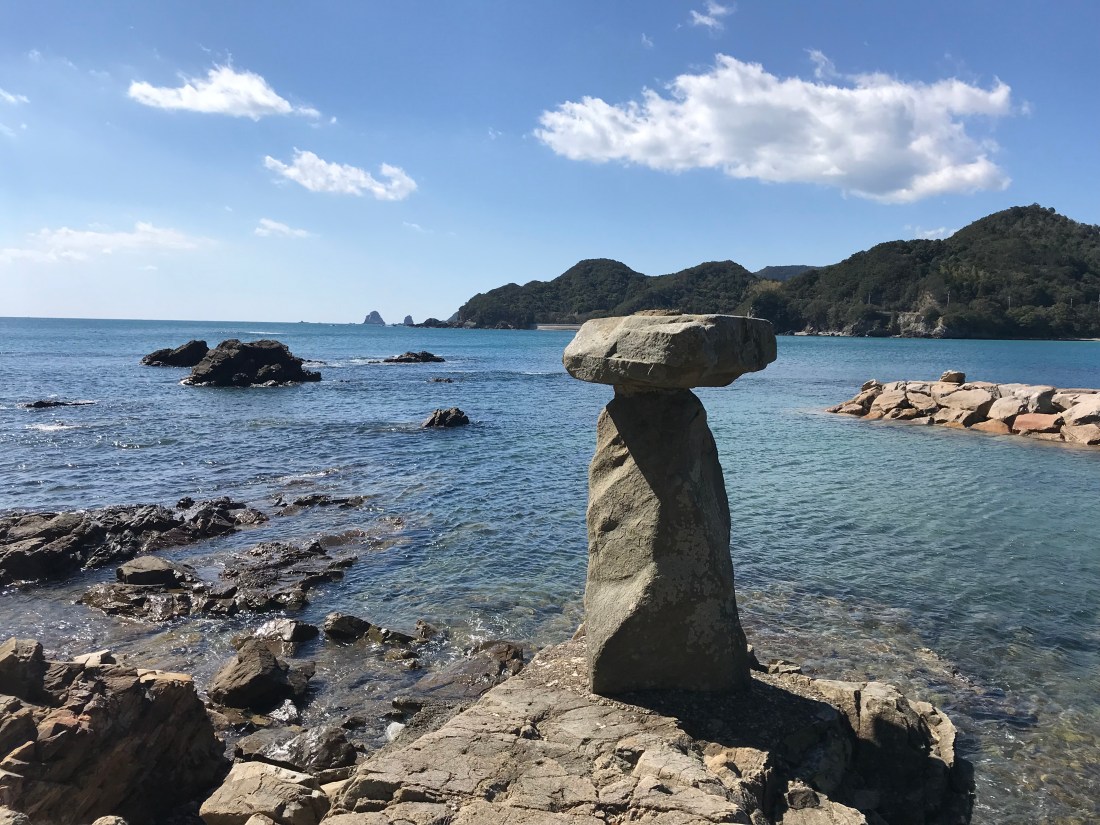
The first image shows a small shrine about 2 miles from the start. Shortly thereafter I met up with Obata-San who was one the diners from the previous evening. We shared the moment when we first saw the Pacific Ocean. The stone sculpture gives one the impression of Kukai.
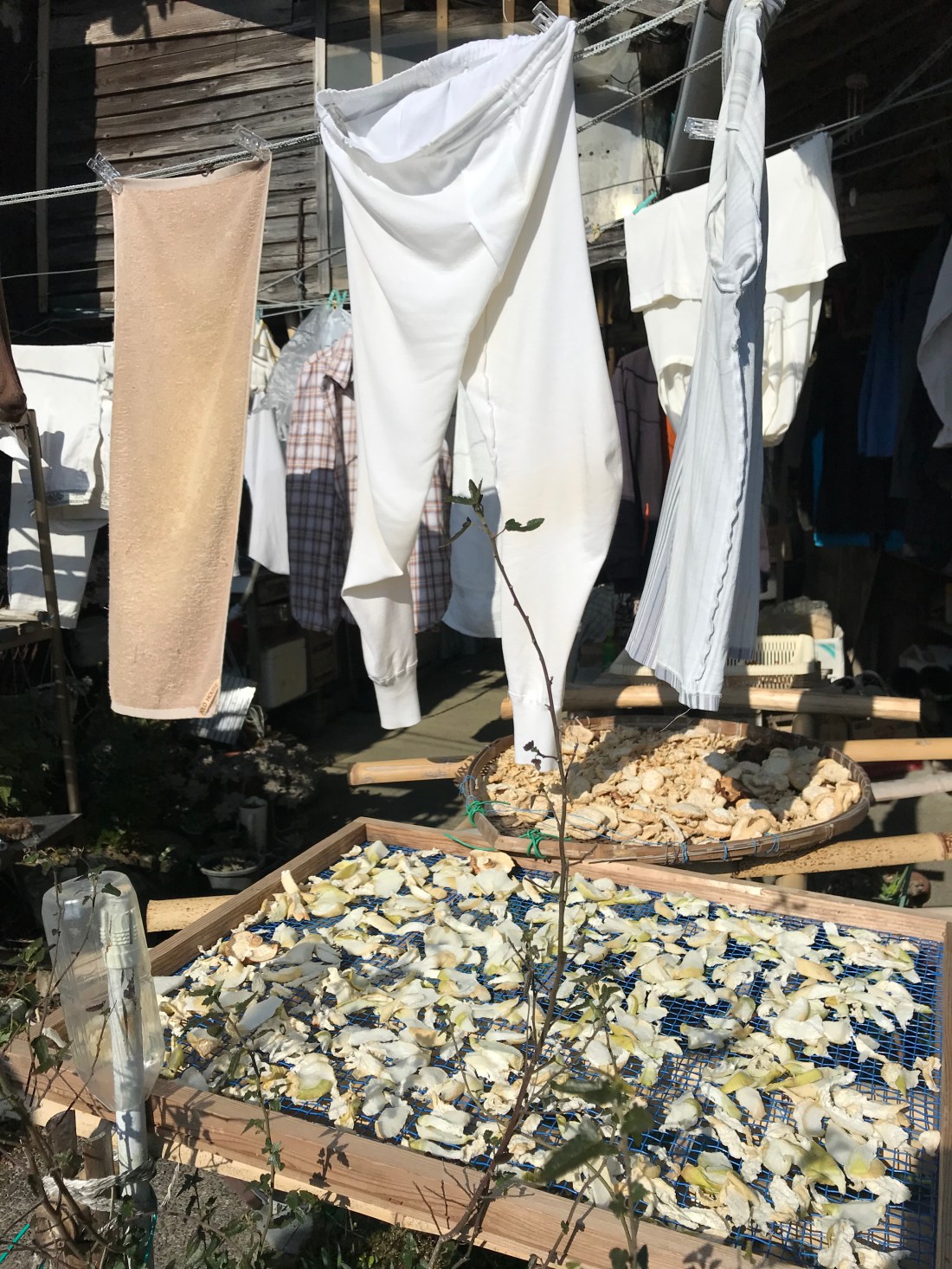
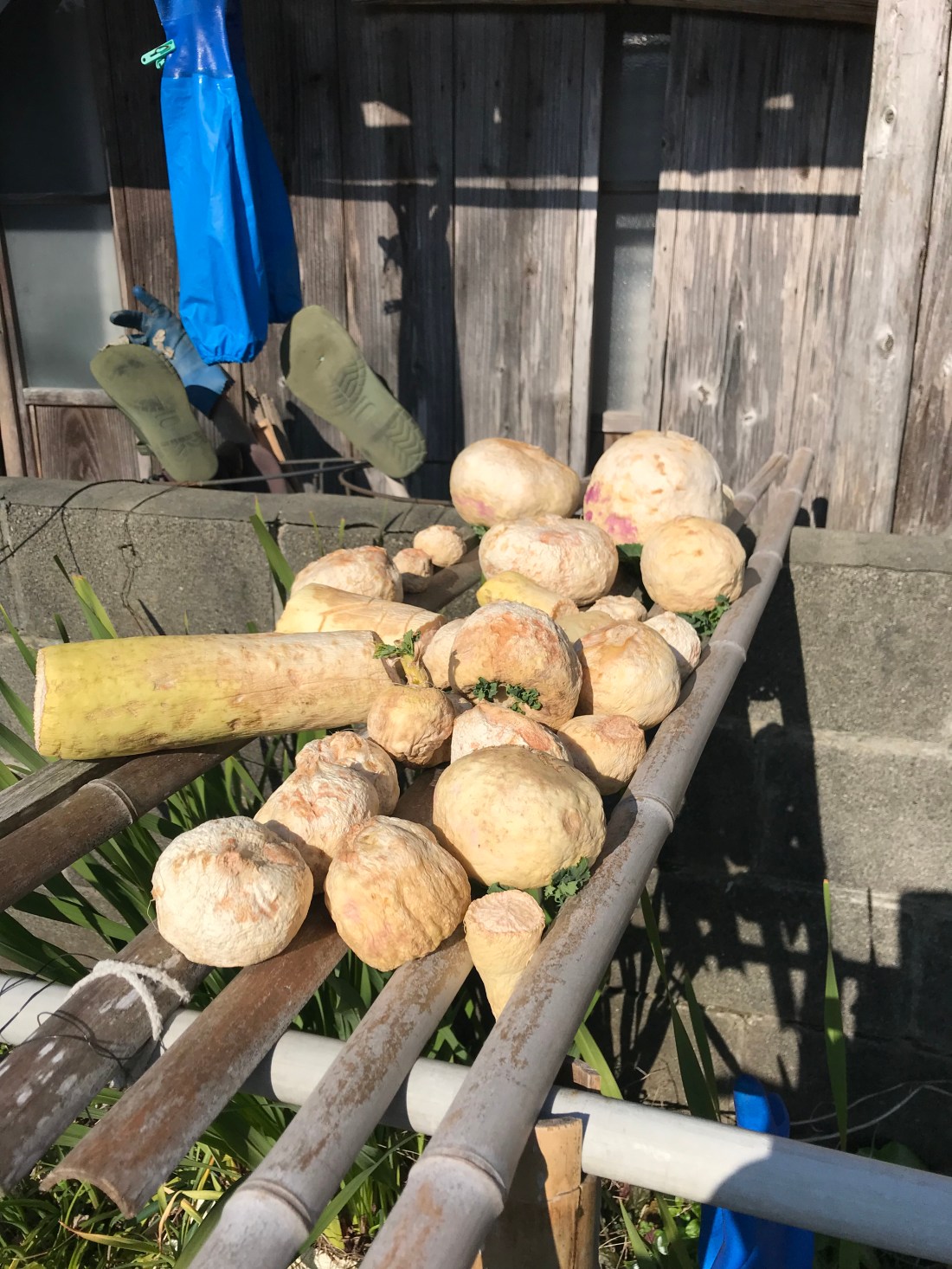
We also passed by a house drying shiitake mushrooms and radishes. No industrial equipment here – just drying along with one’s clothes.
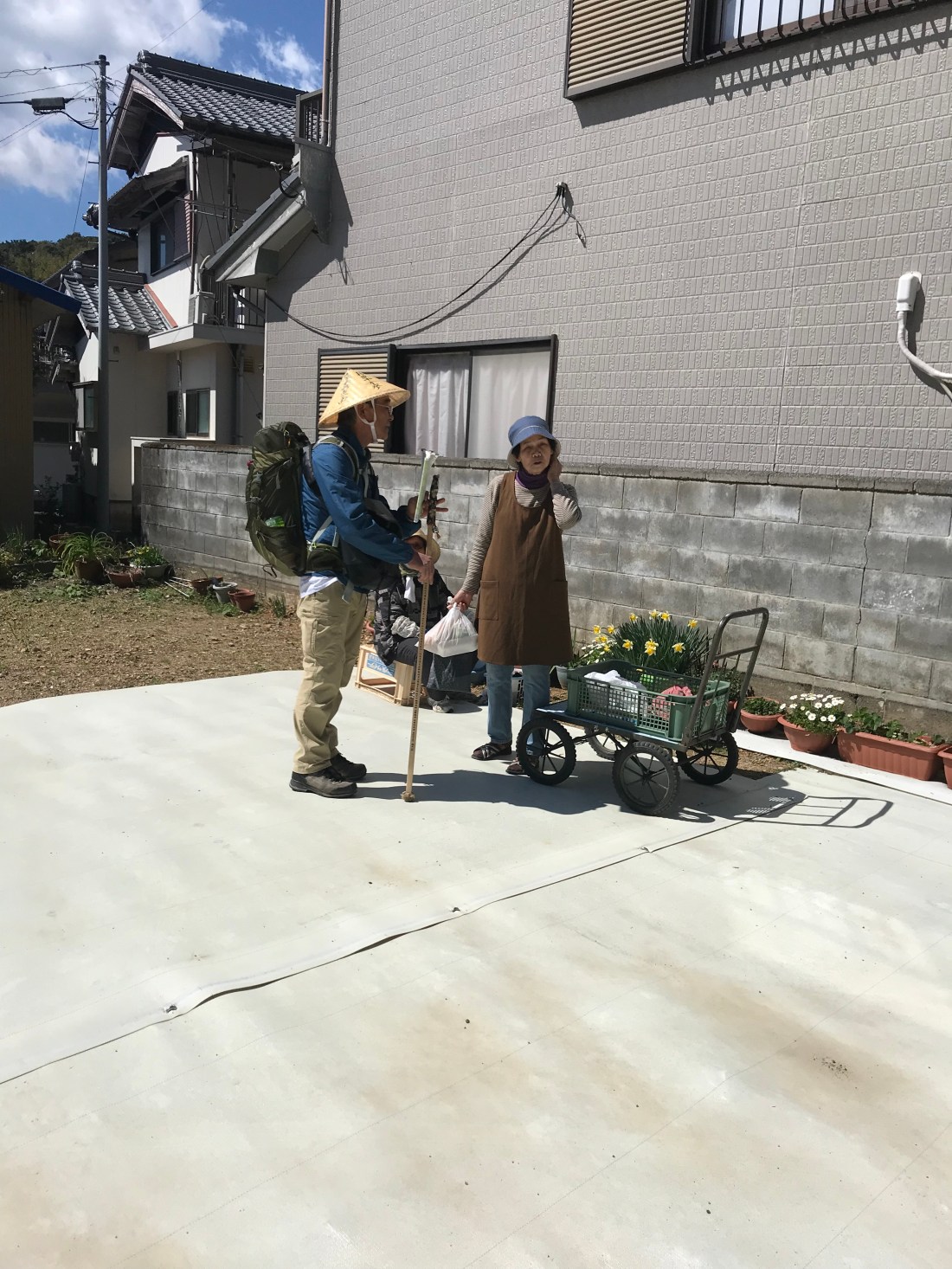
One of the tasks that pilgrims have to do is find places that sell lunches. 7-11 or Lawson (a competing convenience store chain) sell food items. Here is Obata-San asking where we can find food. No convenience stores on our path that day. I also included a photo of a lunch that I bought at 7-11 from a previous day. Sushi like my grandmother used to make.
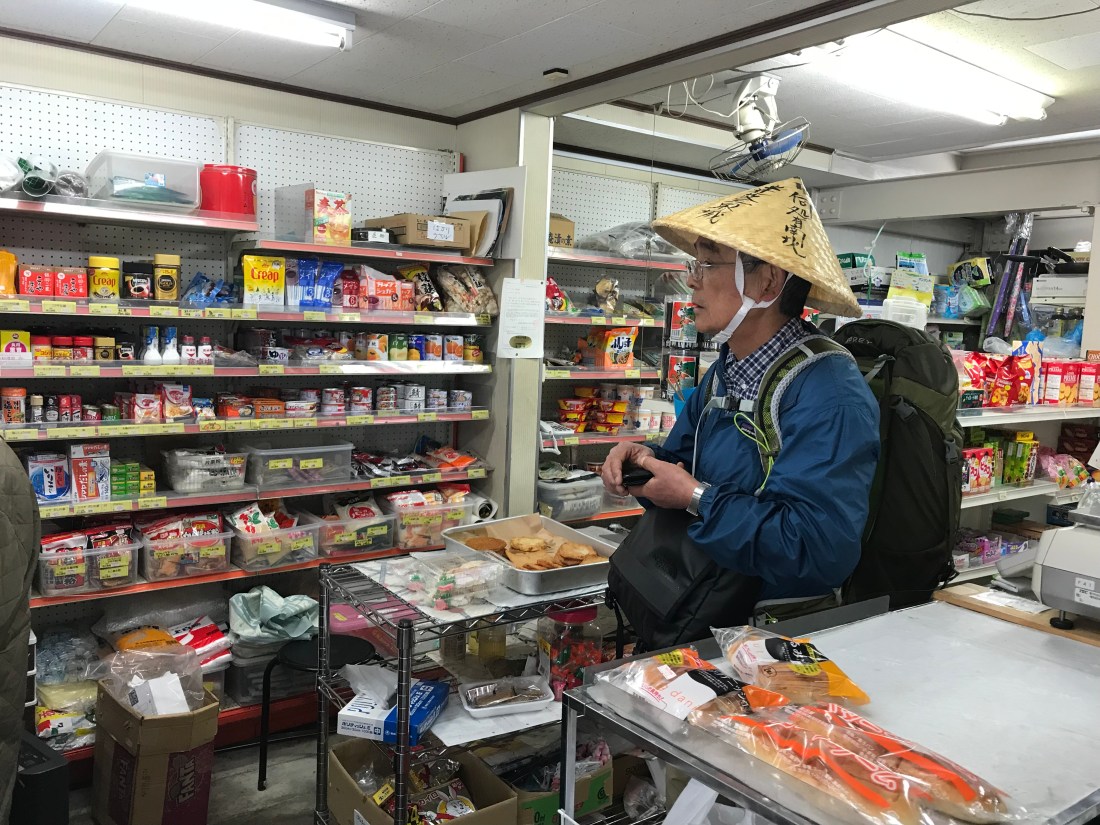
Around 4 PM, I made it to Temple 23 (Yakuoji) which is set into a hill surrounding Hiwasa Town. Obata-San went elsewhere. After performing the various rituals at the temple (I’ll write a blog on the process), I checked into the guest quarters. Sharon and I stayed at a temple at Mt Koya on our last visit to Japan. This one had its own large onsen (public bath) but it was down the hill in a separate building from the living quarters. But it was heaven to relax in its hot water. This temple did not serve meals.

Later, as I was ready to go to dinner with two other fellow travelers who were staying at the local “business hotel.” I stepped out of my room and there was Ayoyama-San. His picture appears the day before at the beginning of the climb to Temple 20. He asked if he could interview me. At the end of the evening, we talked for 30 minutes and agreed to walk together the next morning – 6 AM.

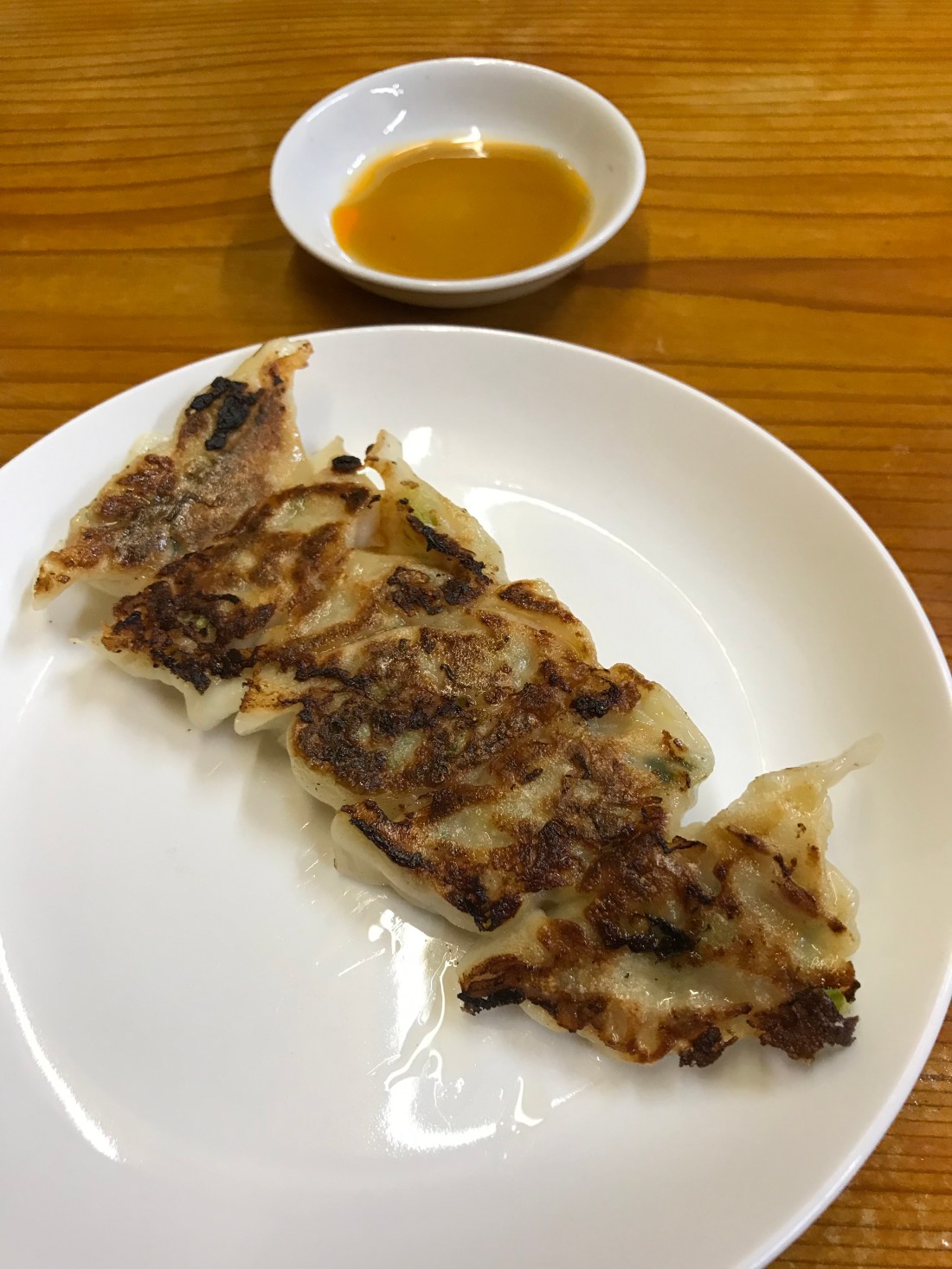
Such meetings occur regularly. To help one another, some people chose to partner up. Here is Monique from Switzerland who teamed up with Josef from France. They met one another for the first time at Temple 6. This pilgrimage is Monique’a second. A typhoon interrupted her first one. She has taken three years of Japanese language courses. Josef is on his first visit to Japan. We were having gyoza, ramen, and yakisoba because my temple lodging did not serve meals and they were in a business hotel.
Back to the temple. Lights out at 9.
Day 9: Twin Peaks (12 March 2019)

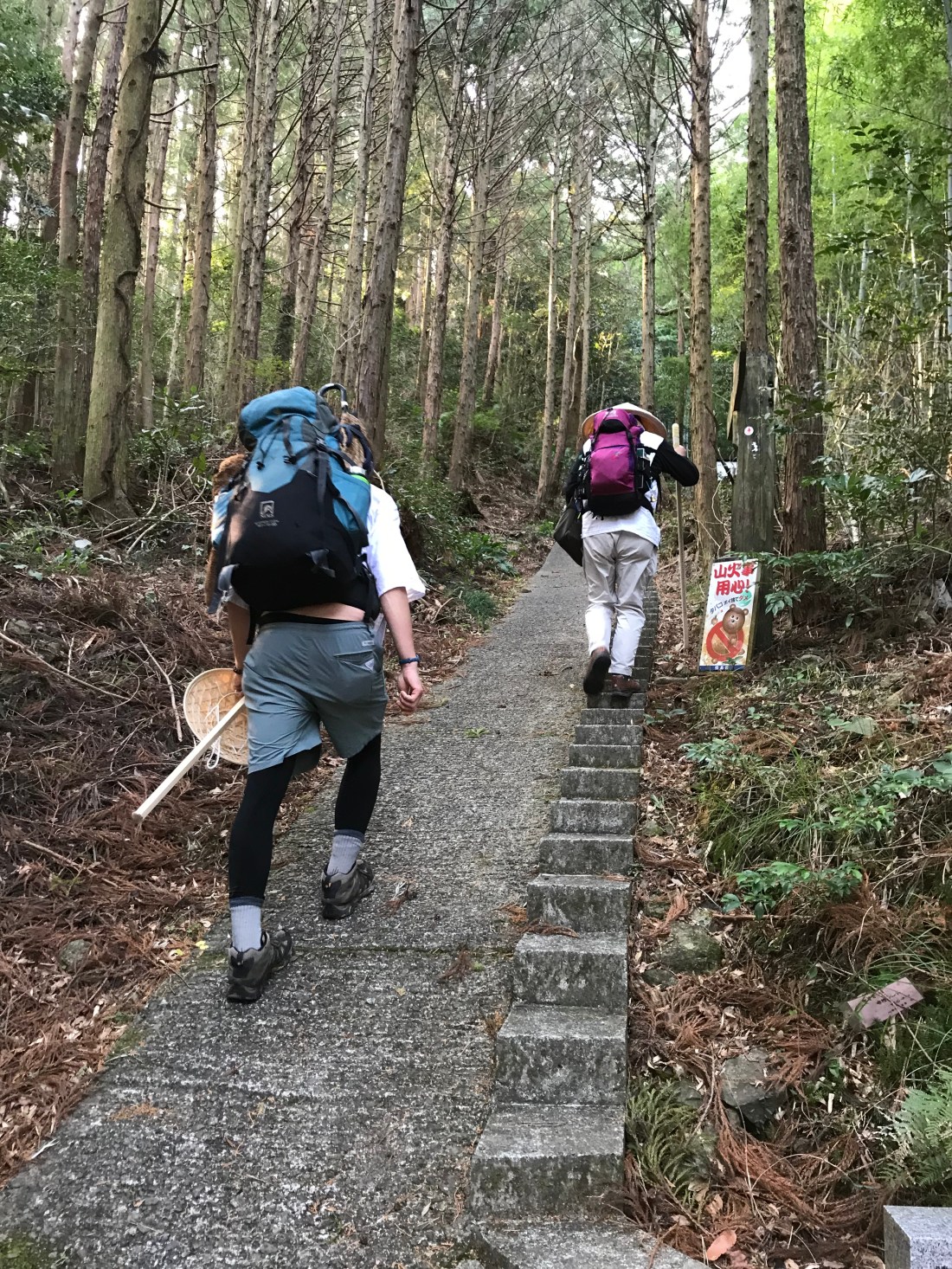
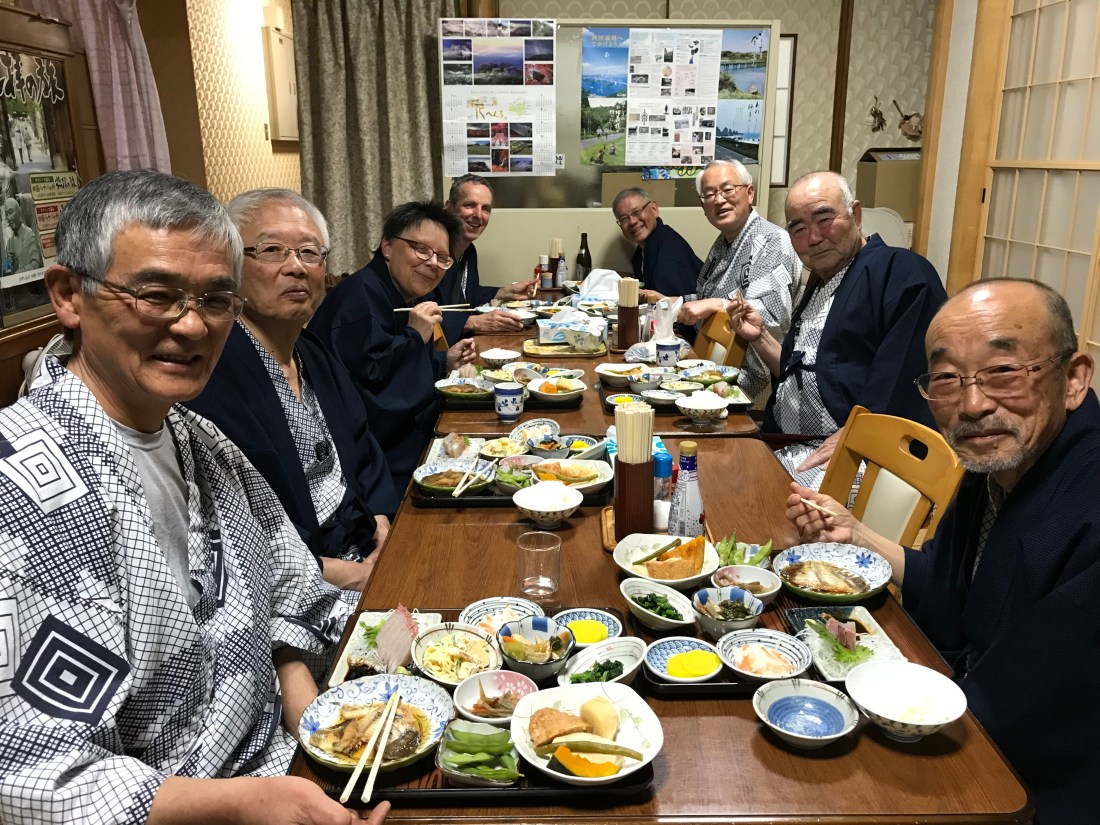
I thought that the climb to Temple 12, Shosanji, was the ultimate test of endurance. But the ascents and descents of Temples 20 (Kakurinji) and 21 (Tairyuji) made this walk as difficult or perhaps harder than Shosanji. We had to start almost at sea level. Temple 20’s elevation is 1500 feet with a very steep climb. We then descended to the river floor before going up again to 1800 feet. When I thought that we had ended our head down uphill segments, we climbed a third hill (500 feet) before reaching Temple 22. Everyone at our inn remarked how difficult today’s hike was. Nevertheless, everyone was in good spirits at dinner – a meal like my grandmother used to prepare.

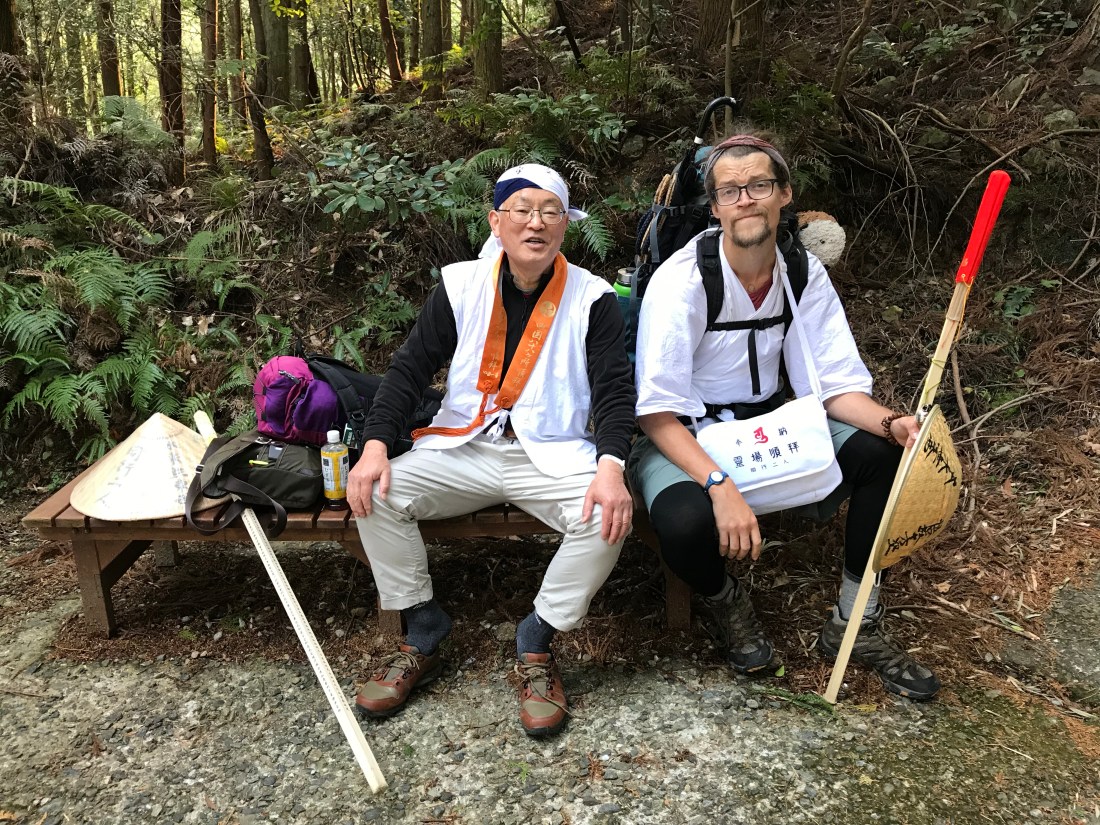
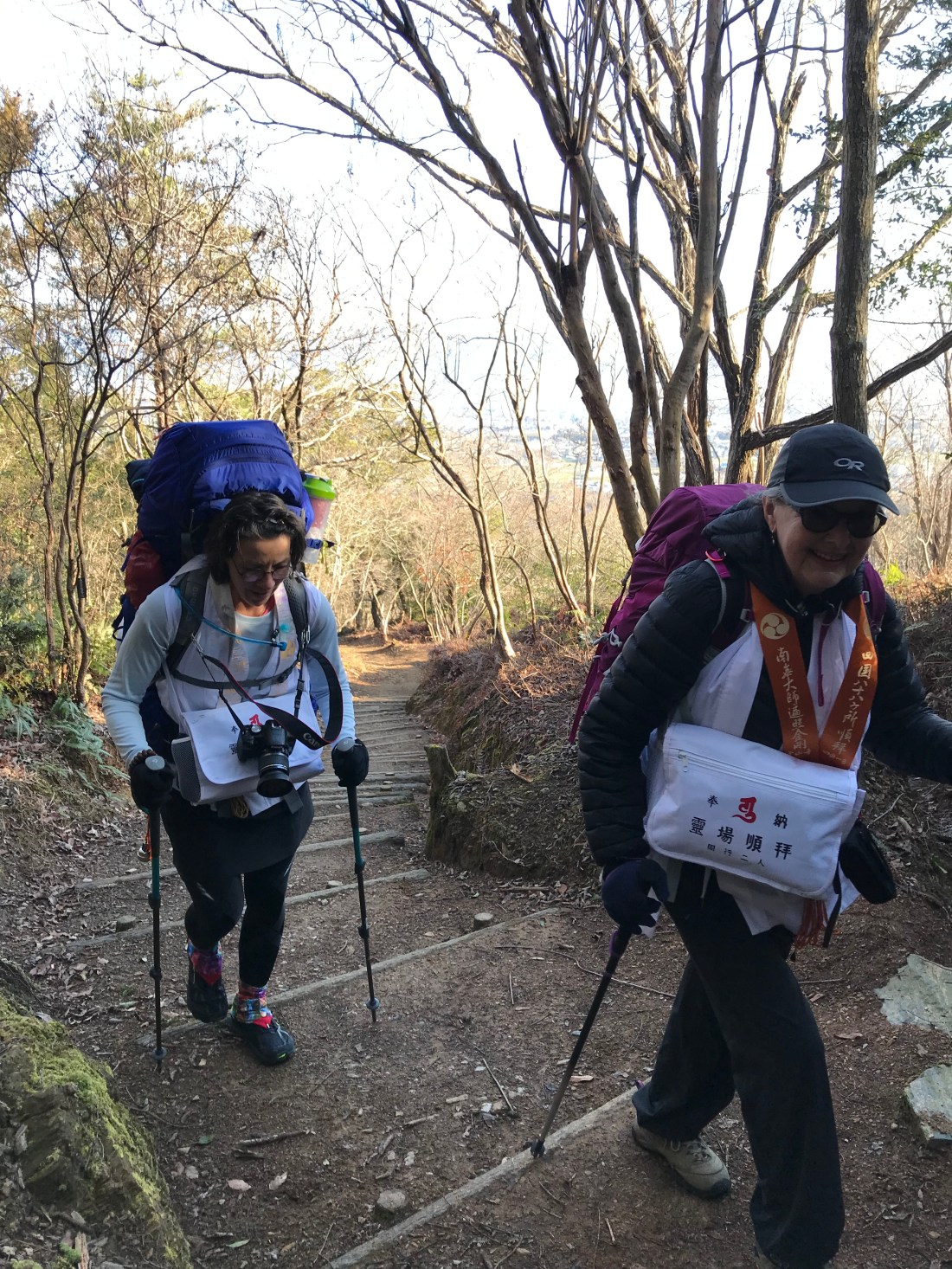
As I mentioned before, the pilgrimage is as much about people and its surroundings. Adam whom I mentioned before as the youngest on the trail, is sitting with Ayoyama-San (Mr. Blue Mountain). Shortly after, we began our ascent to Temple 20.

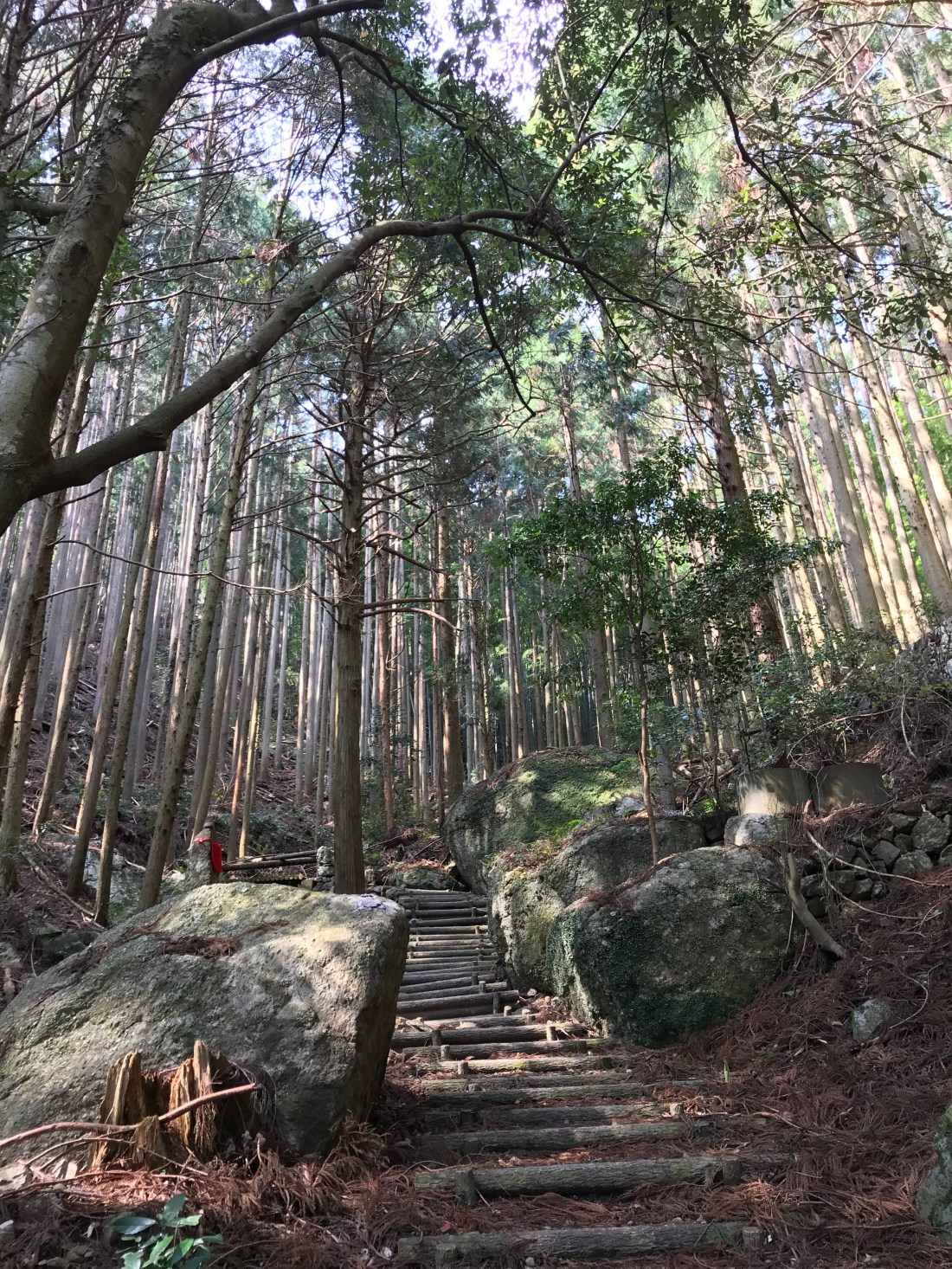
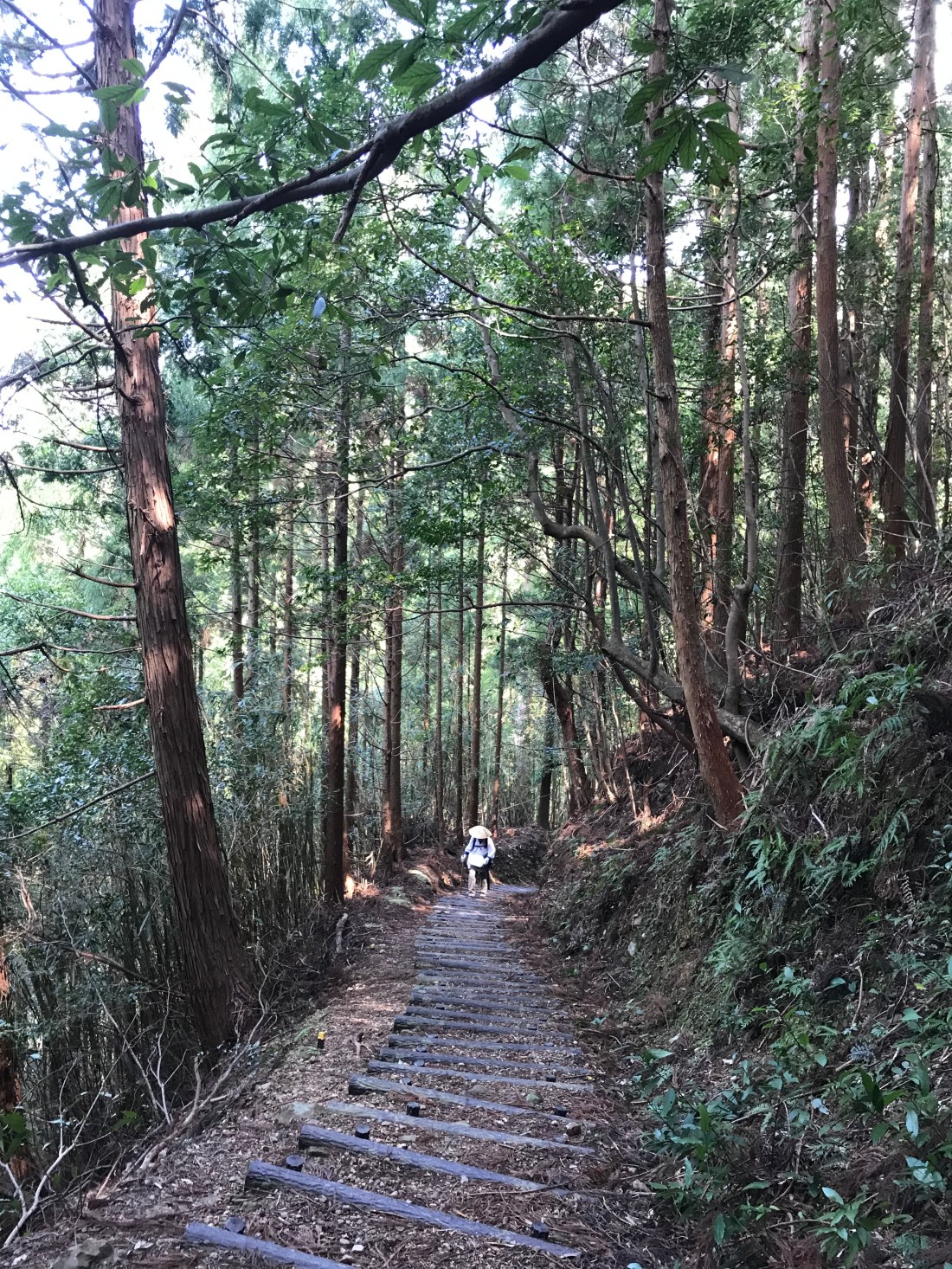
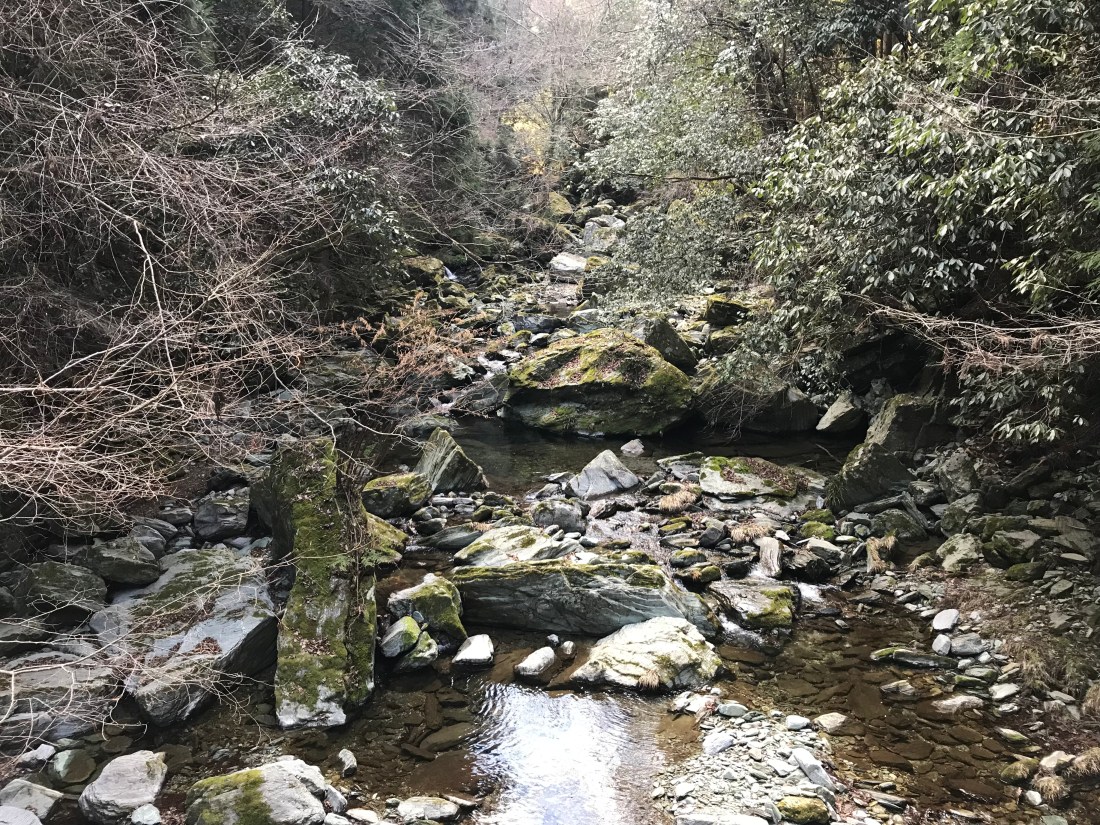
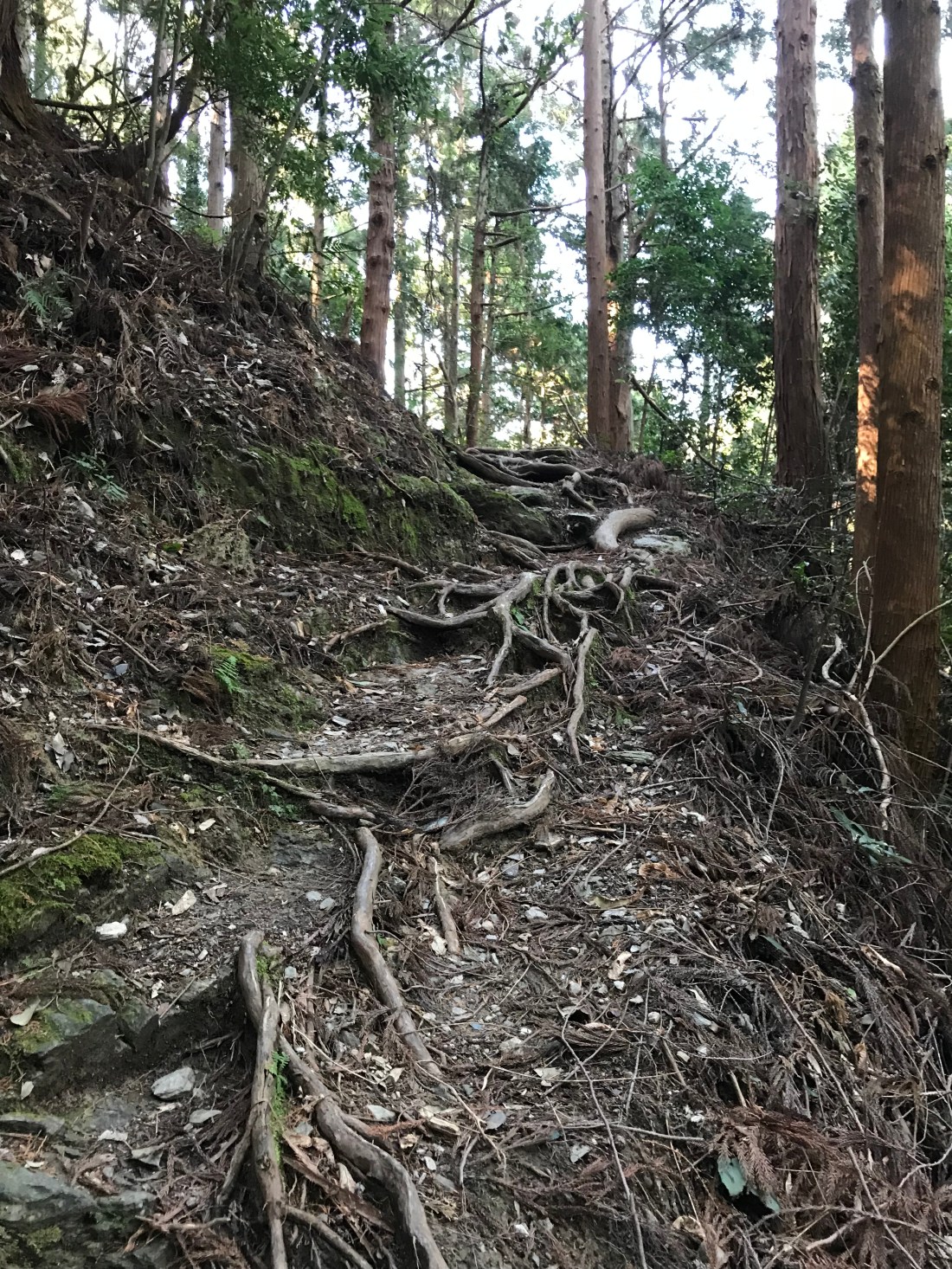
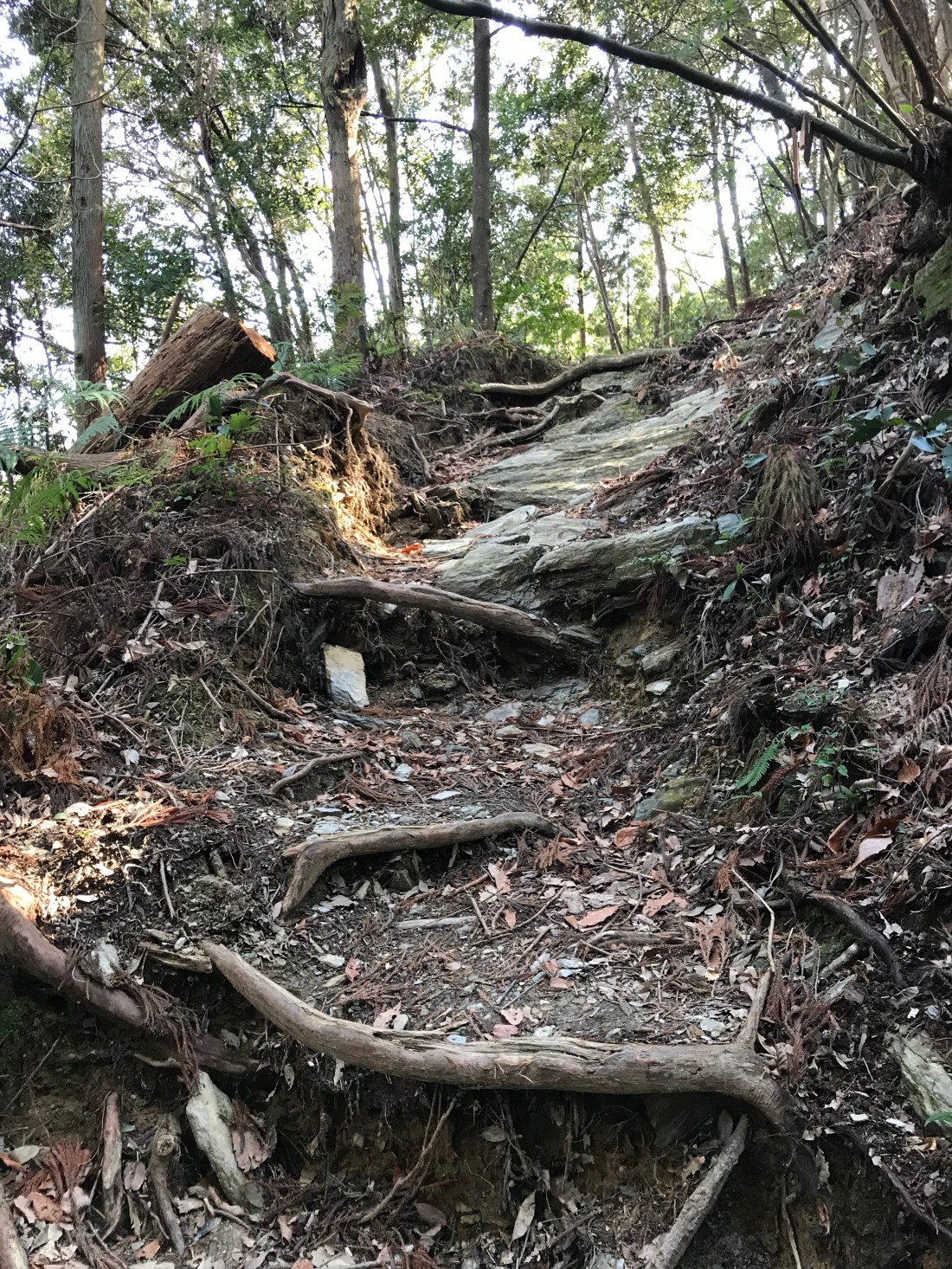
After reaching Temple 20, we began our descent which for at least half time was walking down on makeshift stairs because of the mountain’s steepness. I was particularly taken with the position of the rocks among the forest. What this photo and others cannot give you are the sounds in the forest and the soft breeze that passed through.

After taking these steps for about 45 minutes, I descended to the river valley. The henro path oftentimes finds its way between people’s home. I came upon a beekeeper. How often does this happen at home? Finally, the river appeared and the bridge to take the henro to the other side for the climb to Temple 21.

Here is a fellow henro making his way up the mountain to Temple 21. You don’t have to imagine why he took a break.

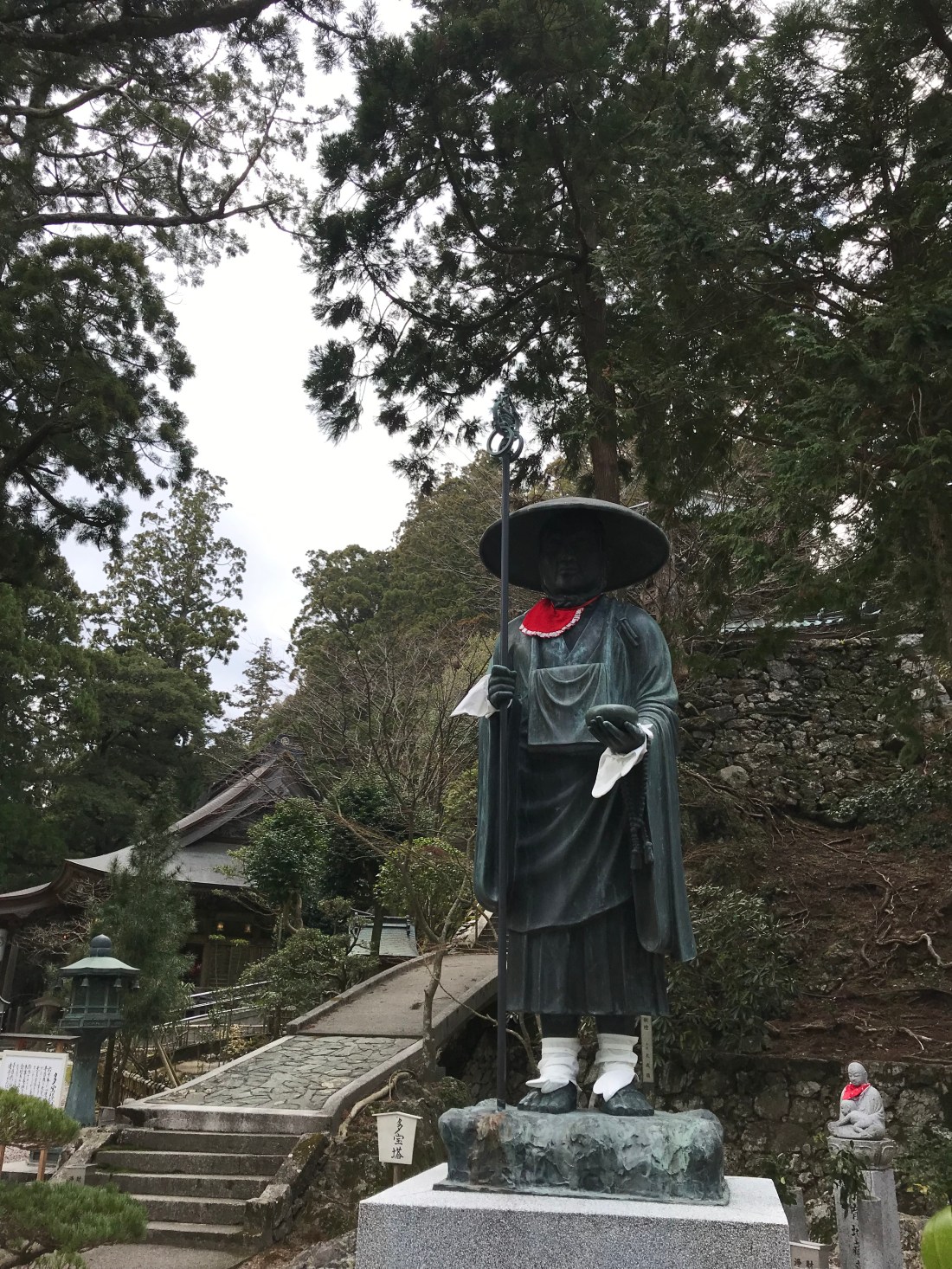
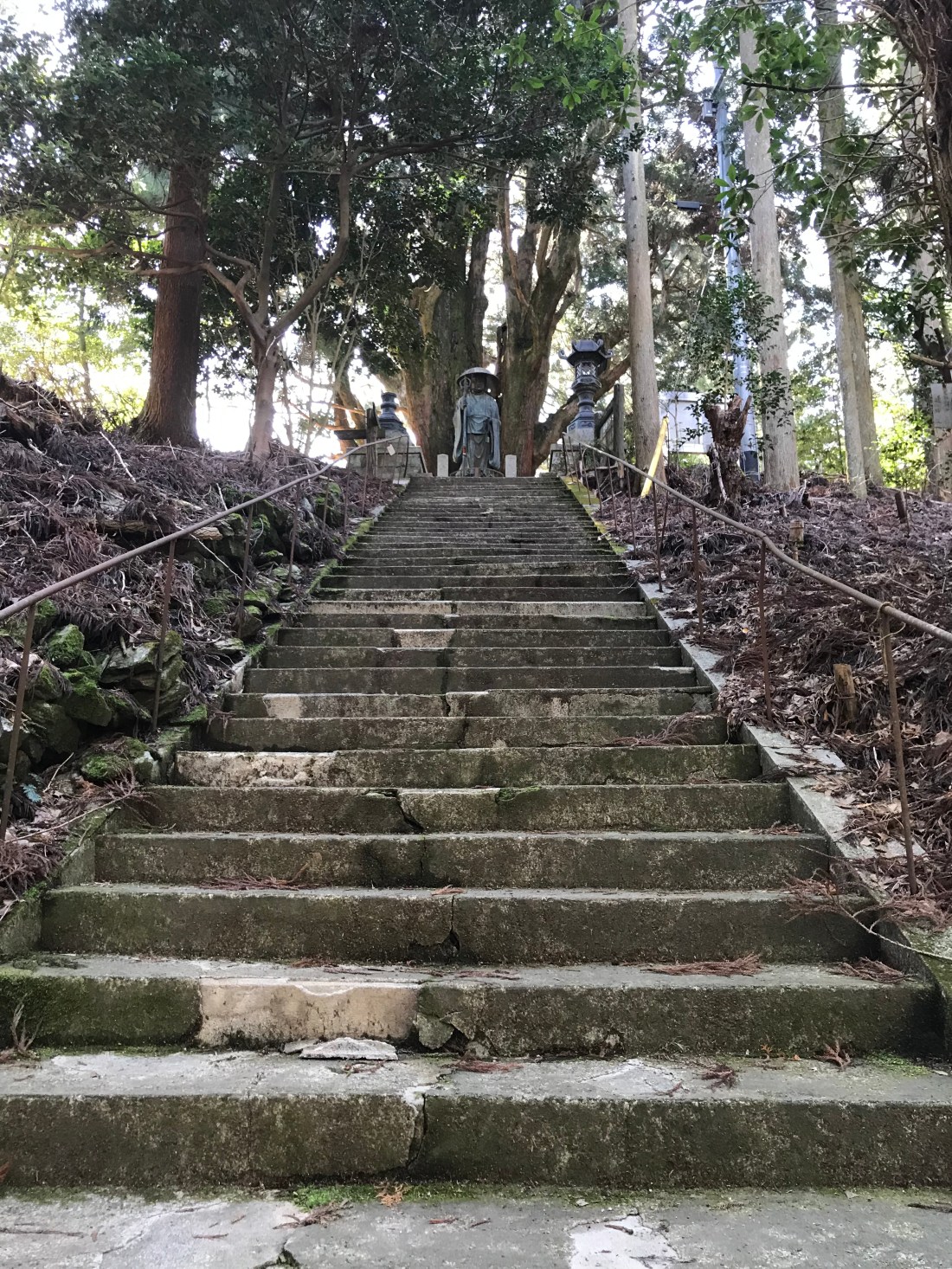
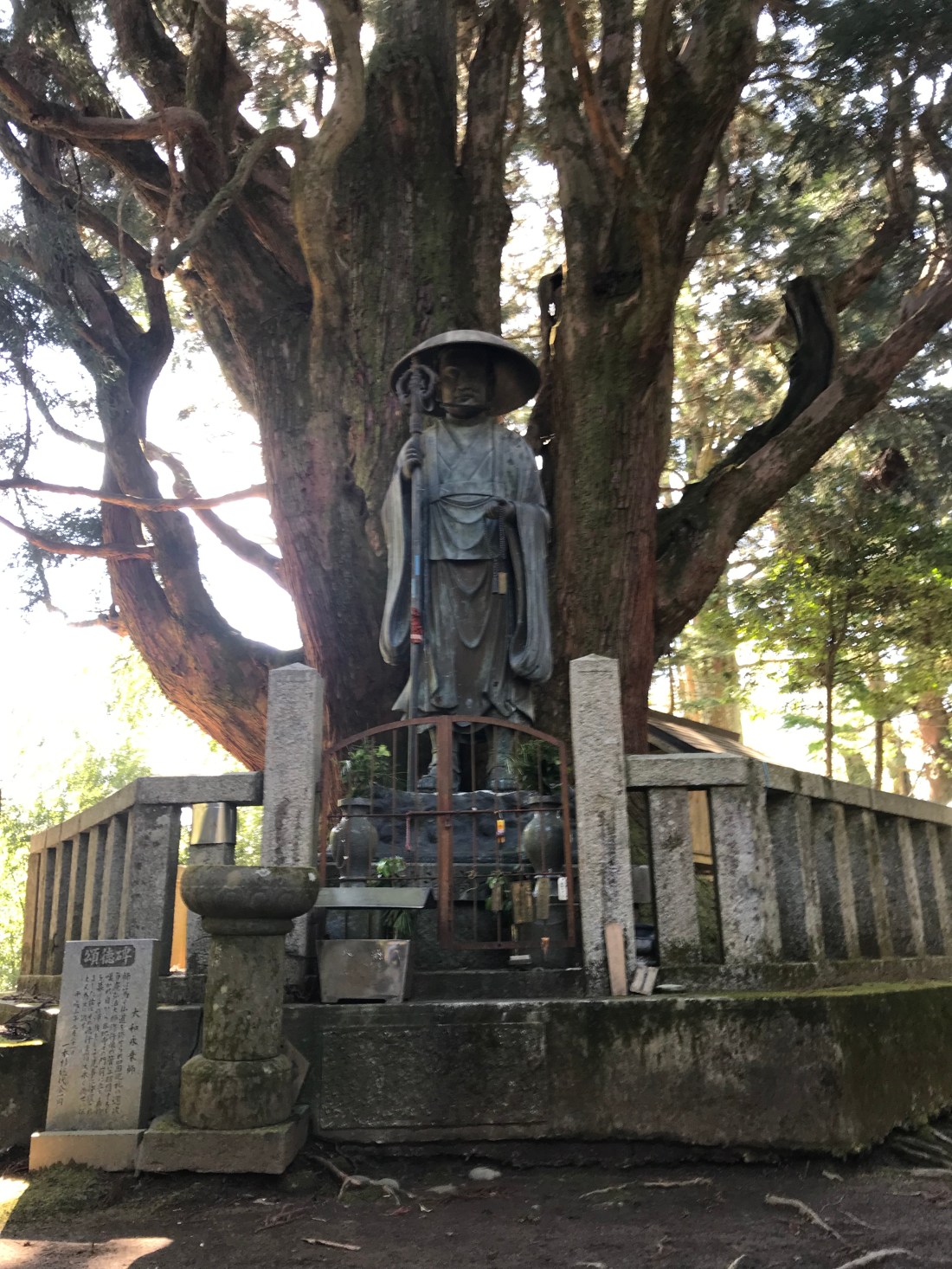
I eventually reached the gates of Temple 21. The temple is set into a forest of very tall cedar and pine trees – a mystical setting befitting a temple in the sky. Here is Kukai waiting to greet pilgrims.

After praying at the hondo and having our books signed, we descended on a road – a welcome change from the thousands of steps we had experienced a few hours before.

I thought that we had smooth sailing down to Temple 22. But to humble us again, we had to a final hill with steps and another steep descent into the Naka River Valley. Finally, the end of the journey for the day was at hand. Again, steep stairs to climb to the hondo. I was humbled for the fourth time.

Fortunately, our inn was right next to the temple. A hot soaking bath, good conversation, and food like grandma (o-BA-San) used to make put all of the guests in a good frame of mind. The evening ended with a very serious discussion on where to stay the next night. Thank goodness that Fukiko is my guardian angel. When I ask for a reservation, I get a quick flood of Japanese that probably only an advanced student would understand. It certainly overwhelms this six year old.

Day 8: Serendipitous Moments (11 March 2019)

Pilgrimages are so much more than visiting temples and churches. What happens in-between temple visits or chats with your fellow pilgrims are just as important.

Today’s walk from Tokushima City to Katsuura Town at the base of the mountain where Temple 20 is located is a wonderful case study.

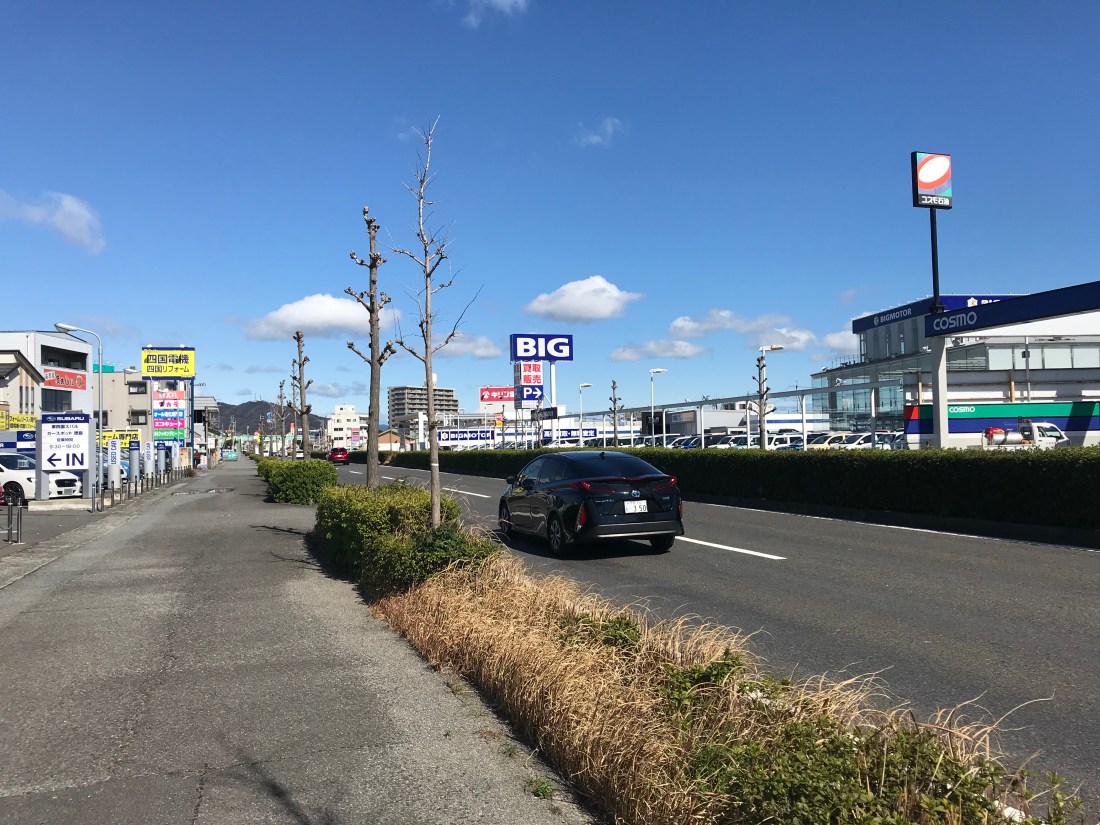
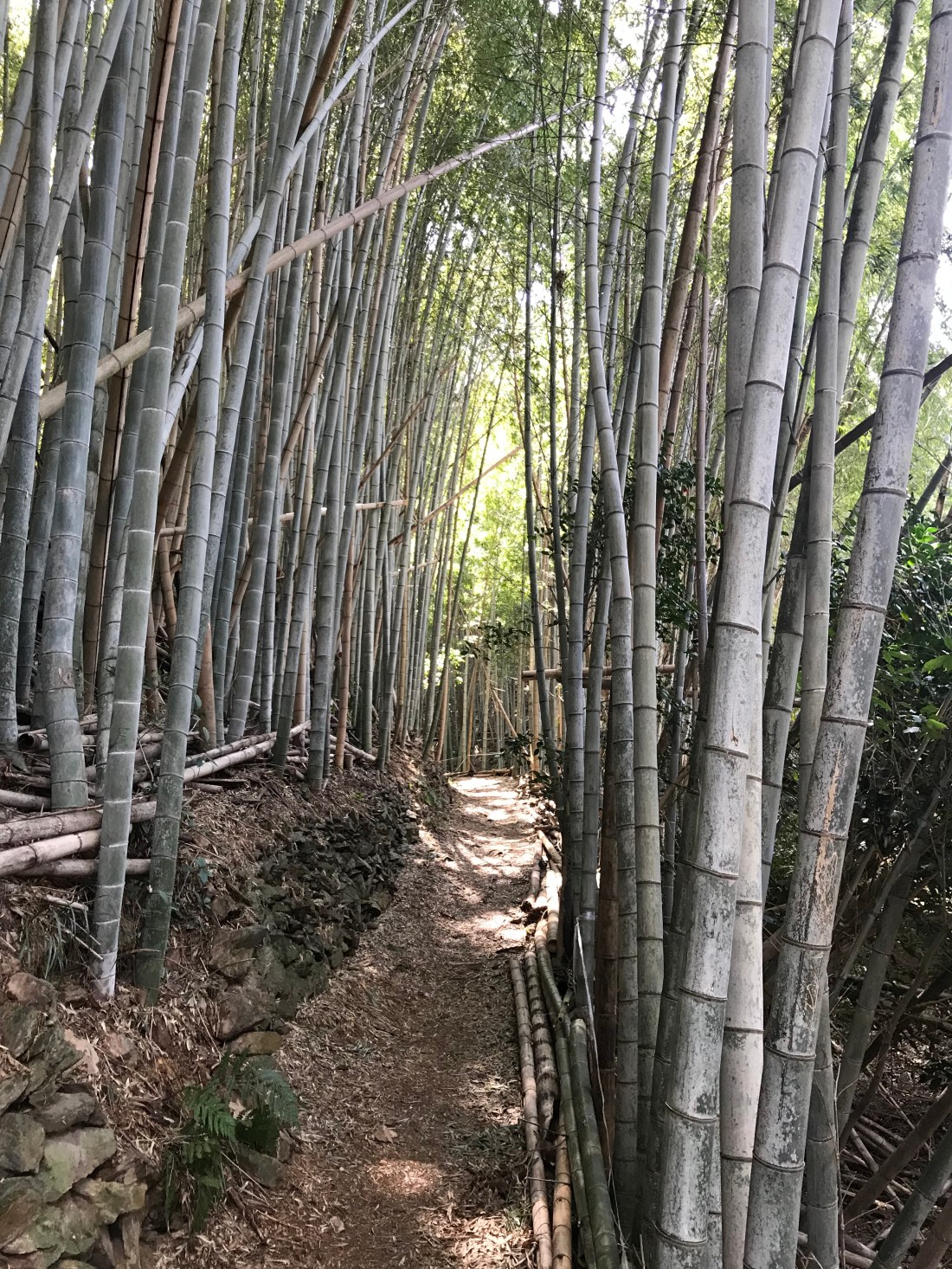
The walk from Tokushima City went from the mundane (the heavily trafficked boulevard with strip malls) to off the beaten tracks like paths in a bamboo forest and in-between farms.

I also came upon this stylized Japanese lantern on an intersection in a small village. How about an art object on the corner of Washington and Linden, for example. Just pick the intersection.

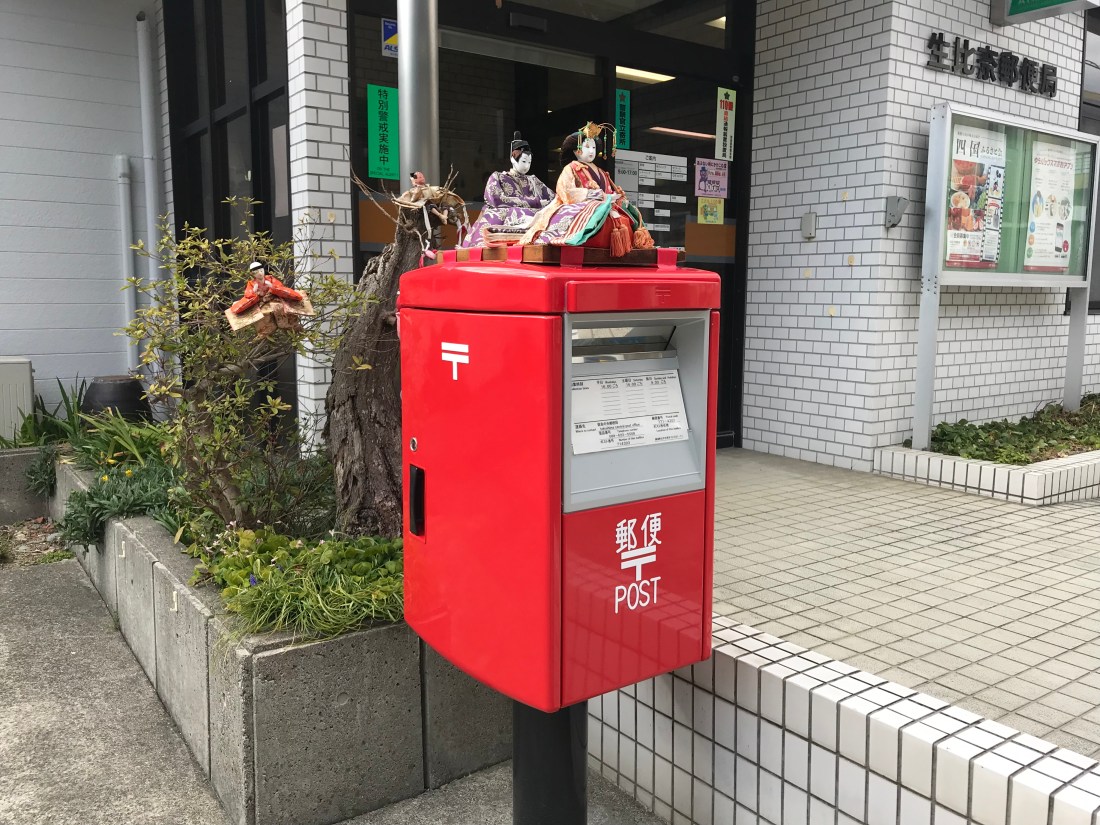
I took this image of Hina dolls that sat on the top of the mailbox in front of the post office in Katsuura Town. How long would they last untouched in our communities?

One final surprise moment. While I was walking to Katsuura Town, a woman came out of a building and handed me two oranges. Dozo, she said. I thanked her and now I have my lunch for tomorrow’s climb.

The pilgrimage is more than just temples. The spirit of Buddhism seems in-grained in the fabric of Shikoku.

Day 7: Walking with Rocky and Hanno (10 March 2019)

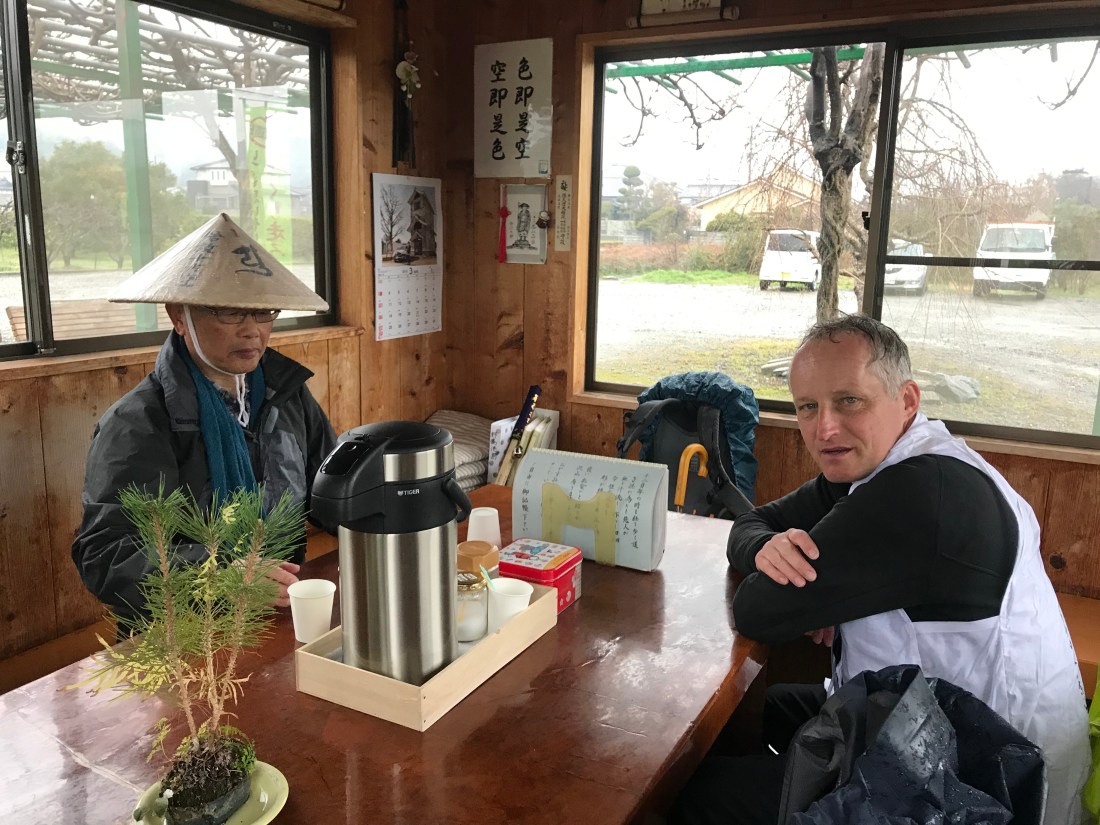
That is, Shiraishi Masaki-San. Family name translated as “white rock.” Rocky is 73. He worked in New York and one day wants to return to Philadelphia to walk up or maybe run up the steps of the Philadelphia Art Museum. He is the oldest walking pilgrim that I have met; the youngest is 33. Most seem to be in their mid-forties to early fifties.

The other fellow is Hanno Eckstein from Germany. He is on an 8 month trip around the world.

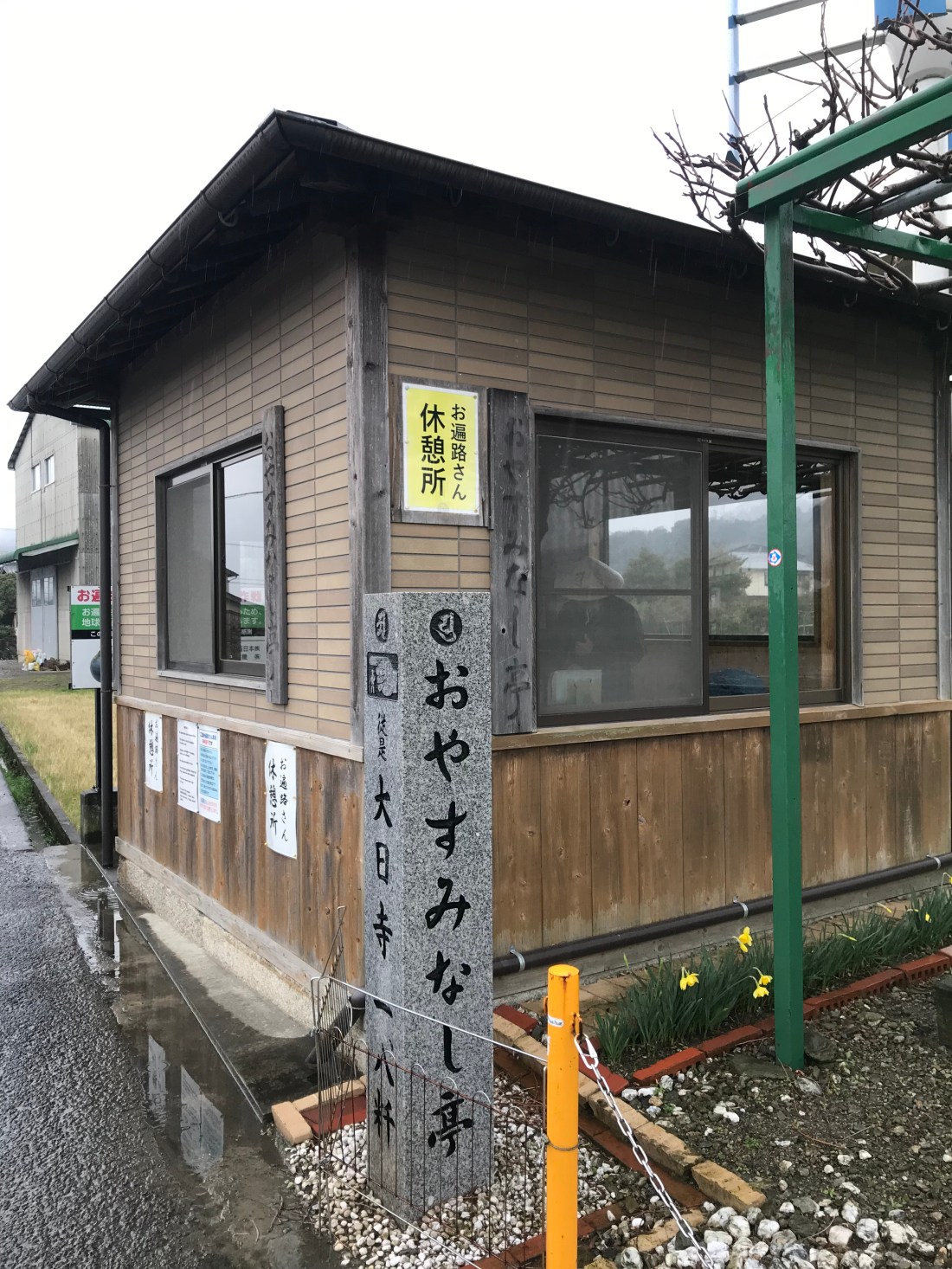
I took the photo of them in a lovely hut set up for henro. It was warm and most importantly had instant coffee and gave us relief from the pouring rain. We walked in heavy rain from 7:30 AM to 6:00 PM. Getting out of the rain with warm coffee at hand brought big smiles to us.

Today, we covered 18.5 miles, 5 temples, and several amusing moments. Maps are very impersonal two-dimensional guides. Walking the roads and trails put us up close and personal with the people, animals, and the environment. Here are a few examples.

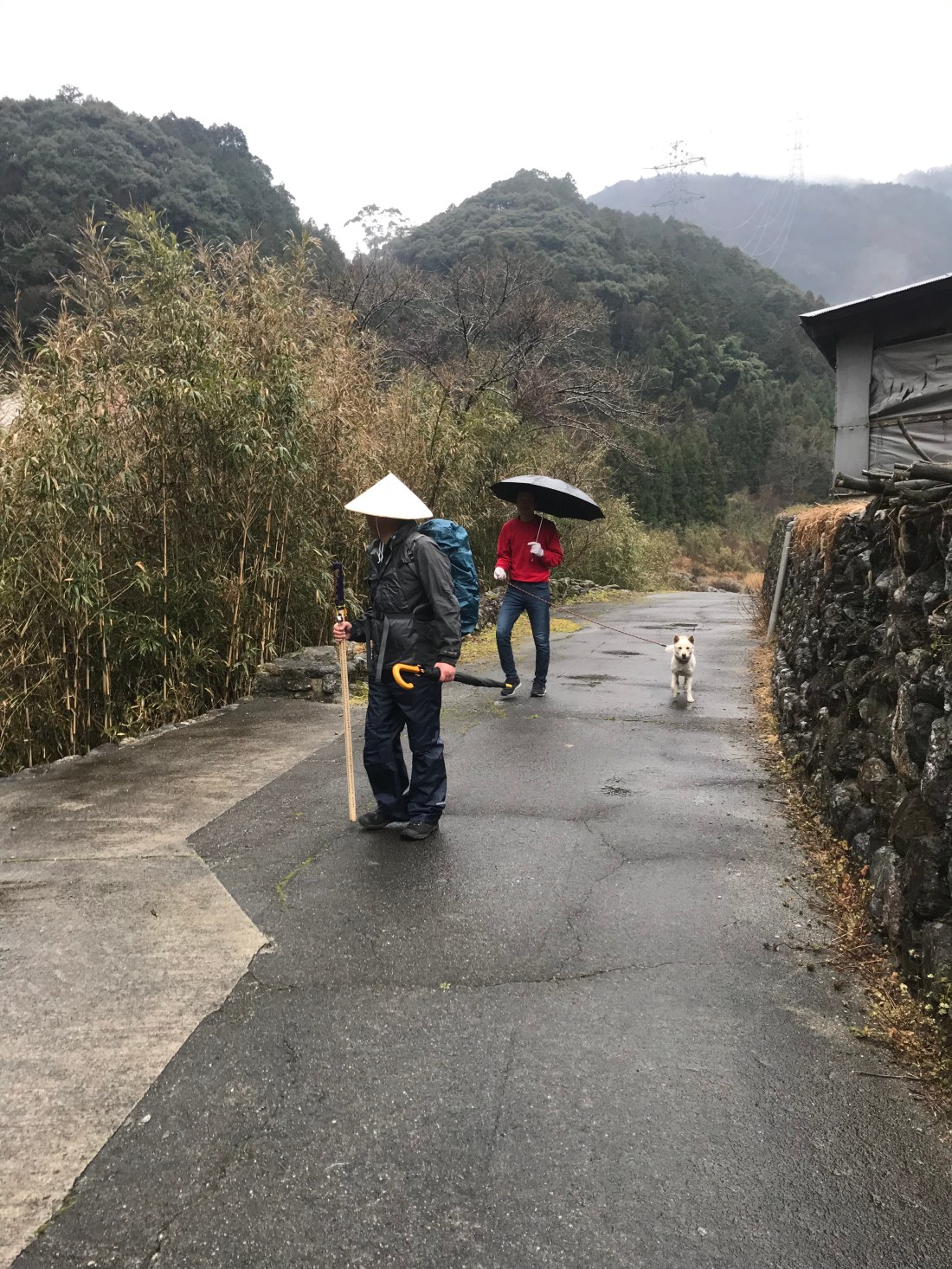
As we walked by the river, Rocky met man’s best friend. I don’t know the breed but the dog looked like a small Akita. He had a very friendly bark. Our henro outfits didn’t seem calm our best friend. Where was Kukai?

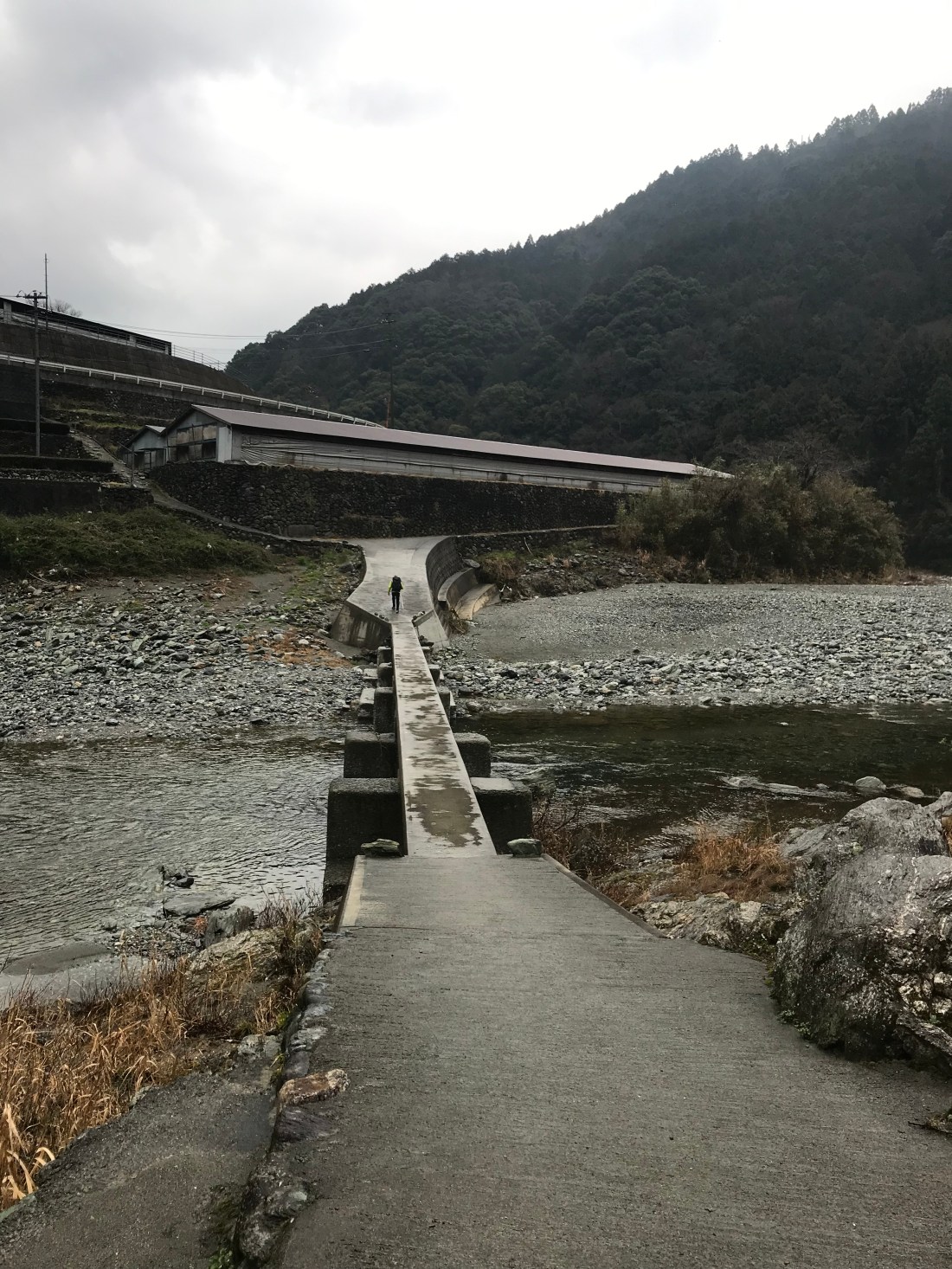
There’s Hanno crossing a bridge. I have walked across several bridges like that one during the past three days; also, some single lane ones for cars and for the occasional walker. I can’t imagine any local person walking across such bridges. The pilgrimage trail often meanders off paved roads. I’ll show you some examples in the next blog.

Here’s Hanno again where we had to closely look for the path marker. Hint: it was on the vase located at the center of the base. We went left.

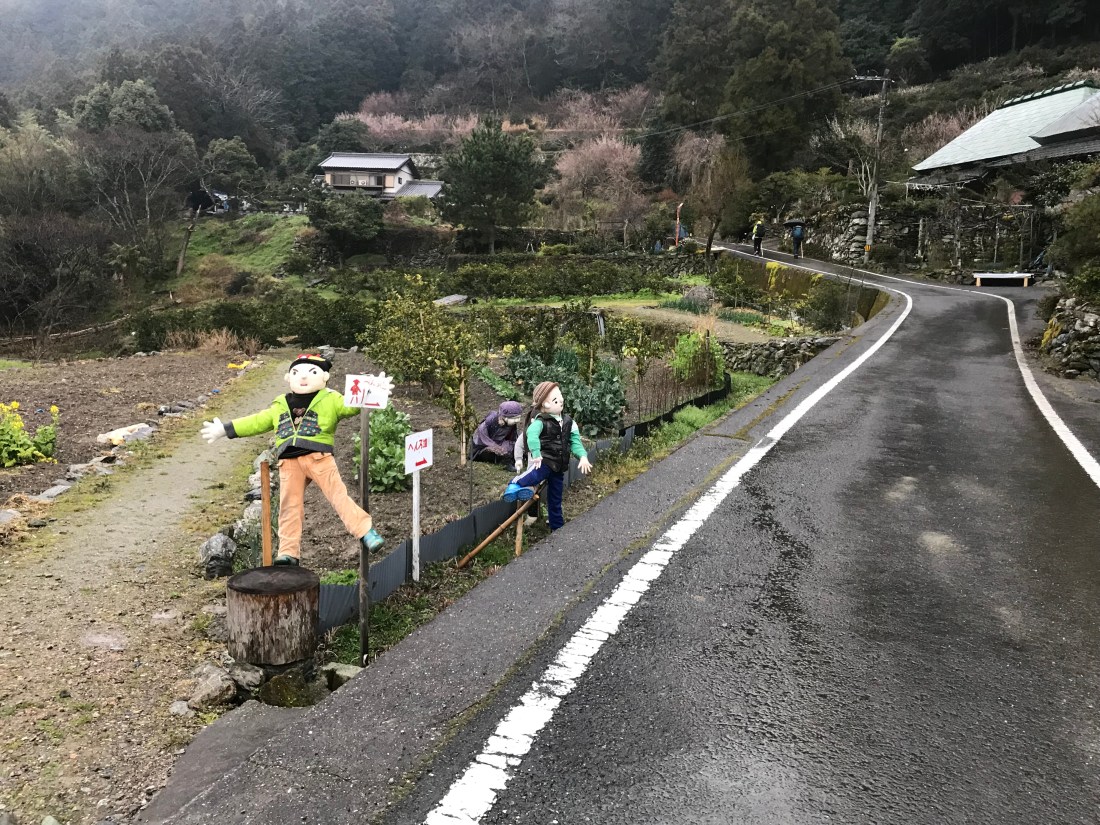
How about the two farmer puppets urging us to stay right.

When we were not concentrating on reading signs, we looked up to see magnificent views surrounding this valley before entering Tokushima City. This is not the Japan one sees in the movies. Almost every walker preferred walking these rural areas and the mountains. Step aside Tokyo.

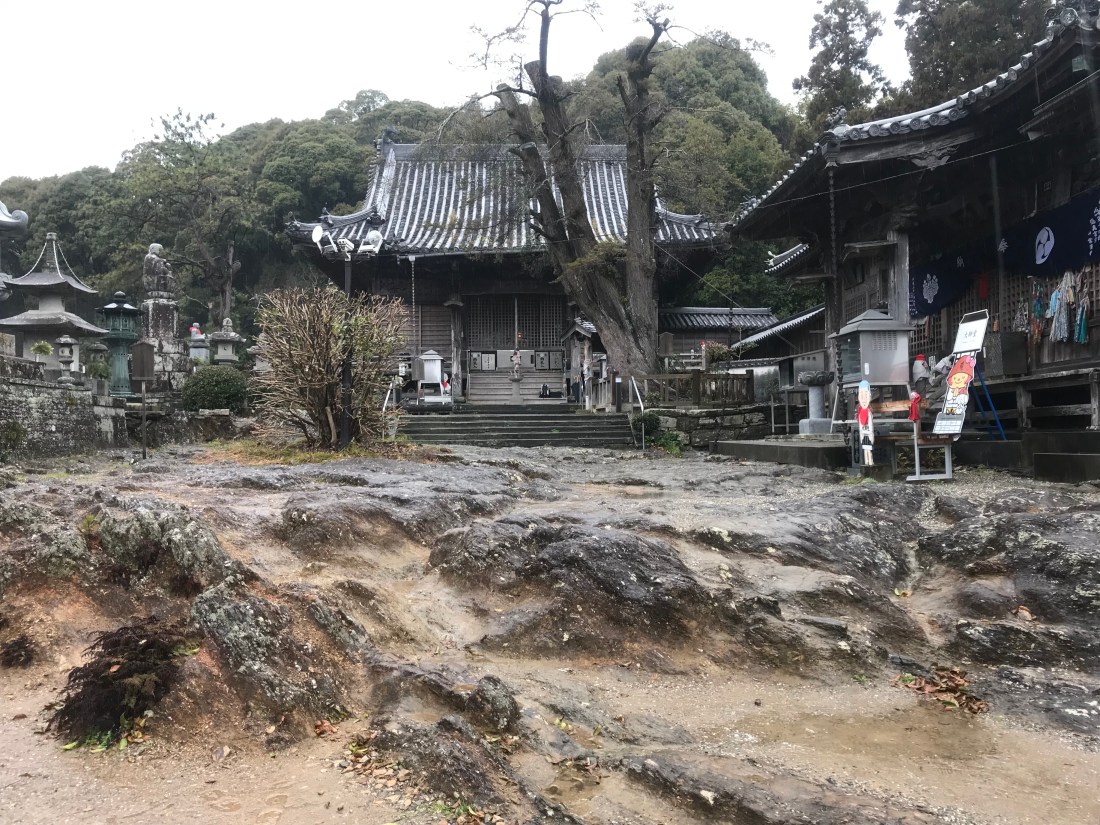
How about the temples, you ask. Indeed, they all have been so different. Here is Temple 14 that was built around its natural rocky surface. No other temple has been like this one. We stepped gingerly because the rocks were very slippery.

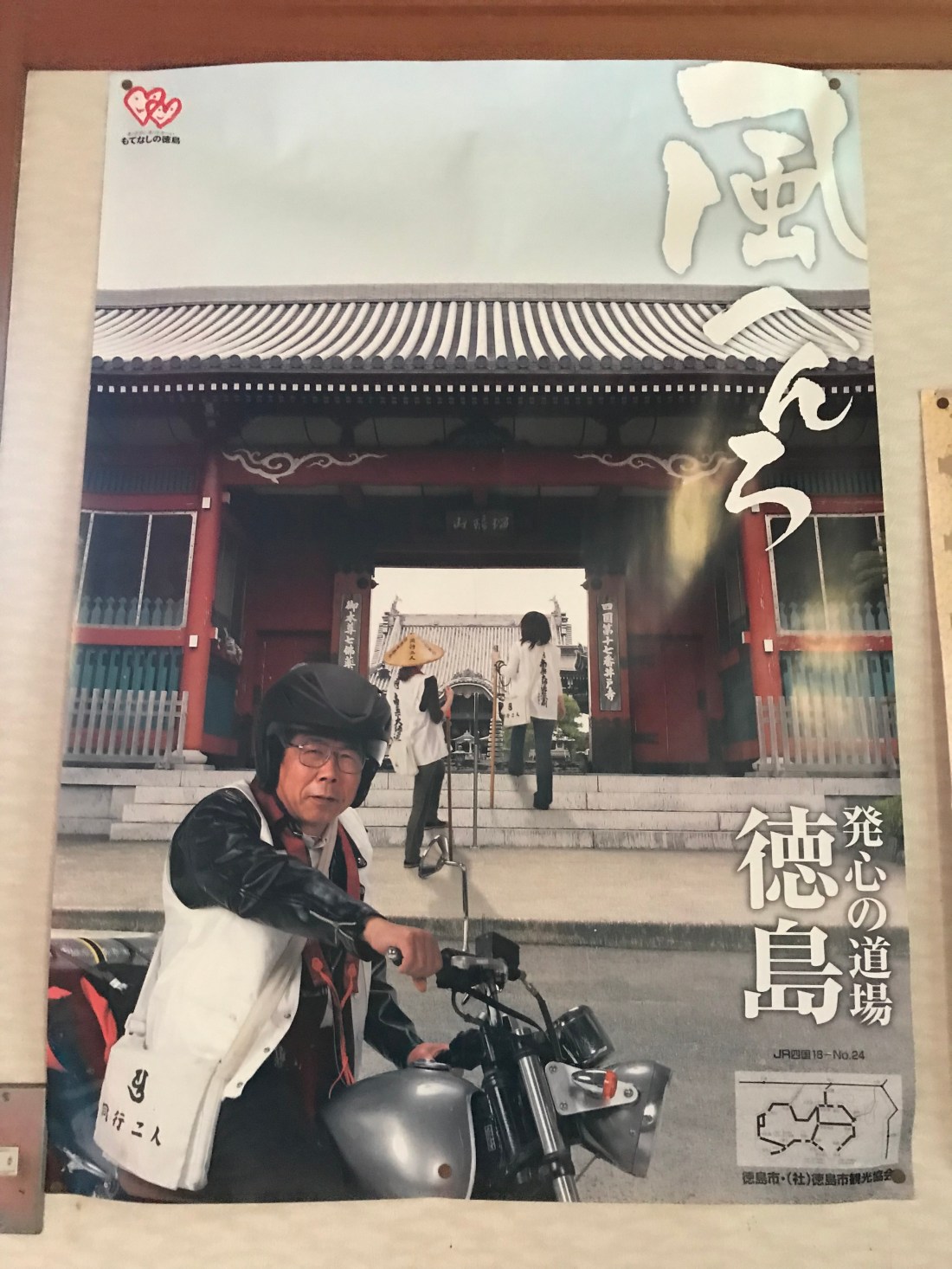
I’ll end this blog with an advertisement that I saw in Temple 17’s waiting area. Touring on a motorcycle! As far as today, other than the three of us, we encountered only one couple. However, several bus loads of Japanese pilgrims were around and about even in the rain.

Day 6: Climb Every Mountain (9 March 2019)

We forded a stream. We did not see a rainbow because the sun was out in force. The only music we heard when we finished was a chain saw in the distance that we had mistaken for Buddhist monks chanting. After eight hours of hiking with over 3500 cumulative feet of climbing, one begins to have some blurry thoughts.

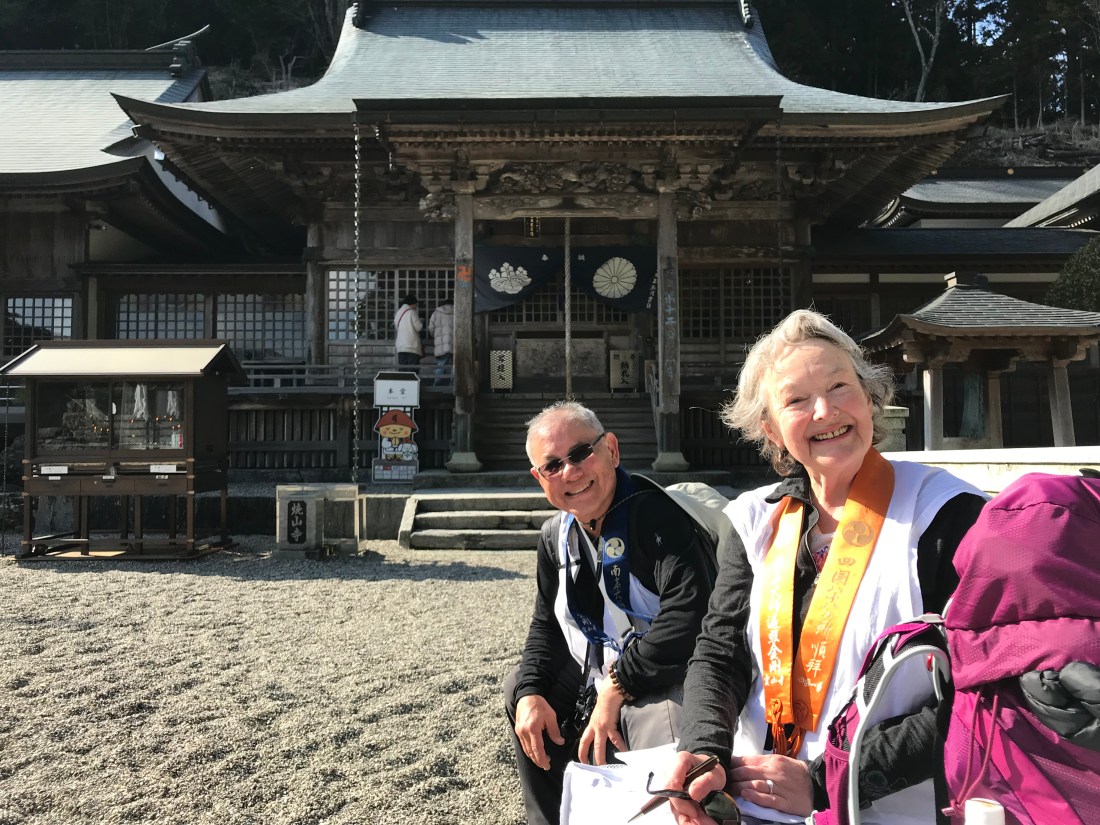
After reaching the plateau at the top of the last mountain, we still had another mile to walk before reaching Temple 12 (Shosanji – 706 meters in altitude. Then, another 50 steps to the main temple area. We were humbled throughout and felt moments of great joy and satisfaction to ring the temple bell announcing our arrival. Here is the moment when we sat down after taking our backpacks off.

Who is that woman? She is Marie Claude Bertrand from Montreal. I met her at the entrance of Temple 11 (Fujiidera) at the base of the climb. She is my age less one month. She has walked the Camino. Her reason for coming – wanting to experience another culture away from the big city.

Unlike some pilgrims who want to reach Shosanji as fast as they can (one fellow, a skinny tall Japanese guy routinely goes from Temple 11 to Temple 12 and back in 4 hours), we decided to savor the natural beauty embodied in the climb. Eight hours later, we reached Shosanji.

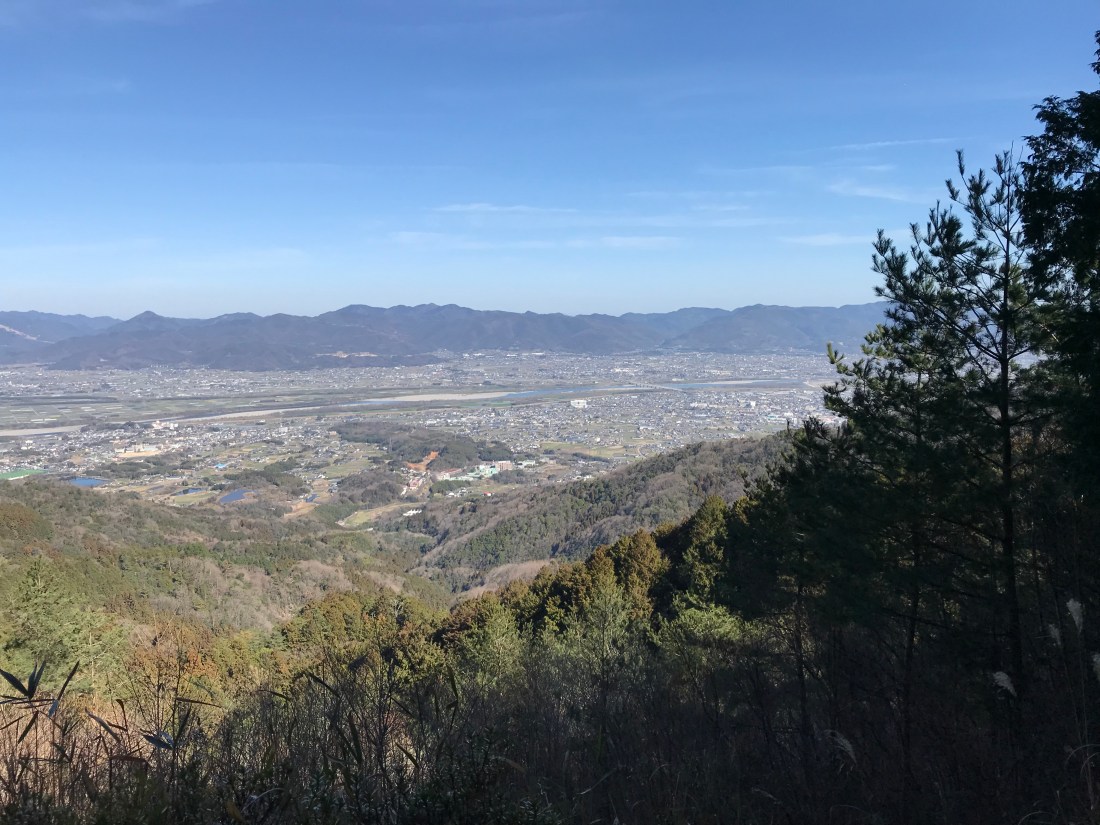
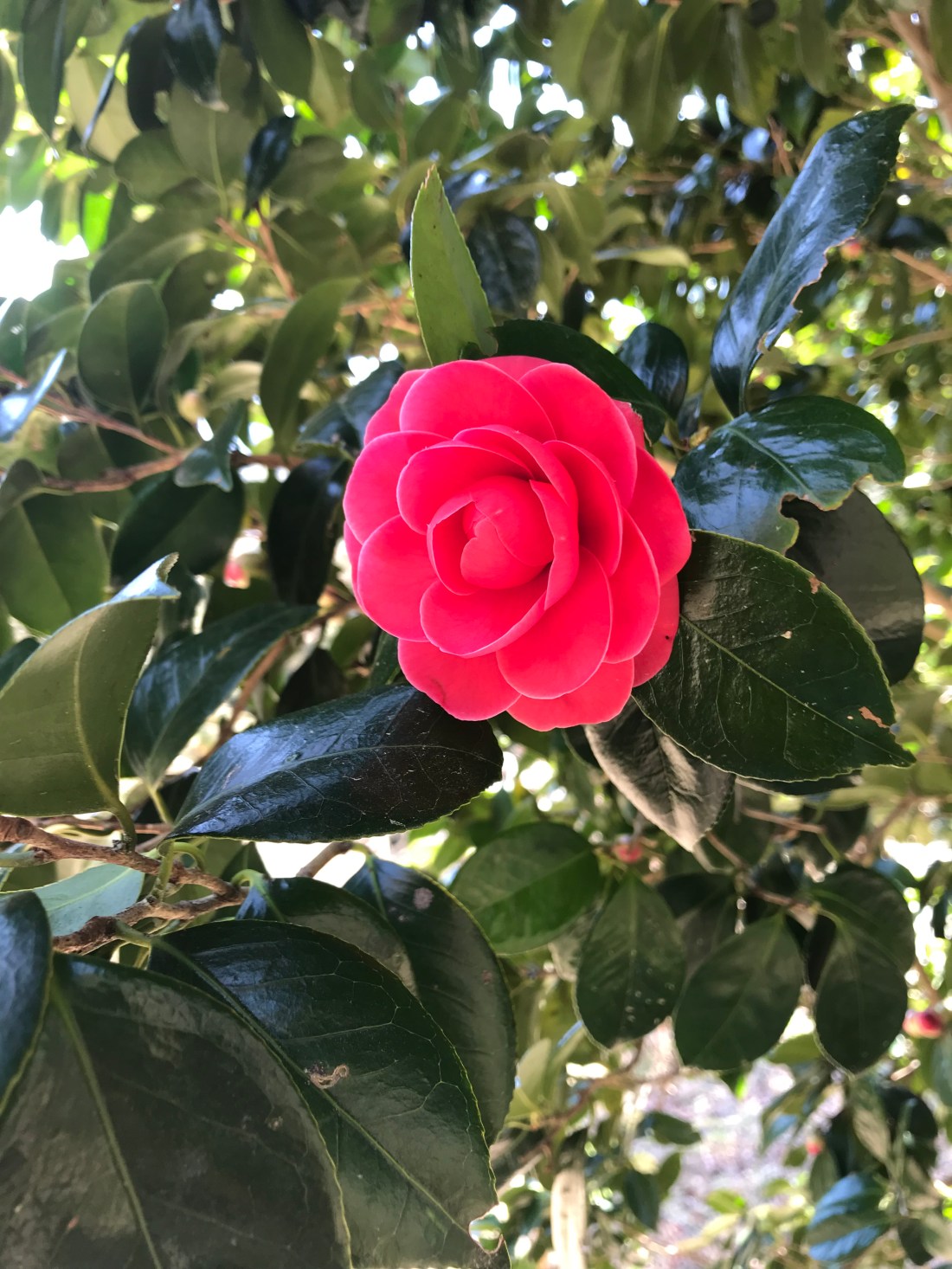
We stopped for photo opps like the two below. The first is a view of the Tokushima Valley from about 1,500 feet. The other is of a red camillia from a shrub at least 15 feet tall.

The climb naturally unfolds in three parts. Part 1 starts at Temple 11 and climbs to about 1,700 feet and then descends 400 feet. The trail is well groomed, smooth, climbing gently with a few ascending sections. A sign appears that to the initiated seems to indicate that only 3 miles lie ahead to the end. See the photos of the start of the climb at Temple 11 and Marie Claude and another Canadian, Wendy, a retired RCMP officer from Nova Scotia hiking up a steep portion of the trail.

But the second climb begins. Pilgrims ascend 700 feet on a switchback path. The photo of a sign during the climb says, “Ganbi,” keep trying. At that point, your legs feel a bit soft.

Halfway up this climb, you begin to question why you are putting yourself under such stress. About 30 minutes later, as you near the top, a statue of Kobo Daishi appears, of course, with the obligatory stairs to climb. Marie Claude clasped her hands together in a prayer gesture and said, “Thank you Kukai” (Gobo Daishi’s real name).

Alors, we discovered that we were only halfway to Shosanji. Another descent and climb were ahead.

If one still needed a spiritual awakening, the final climb did the job. We “forded” a stream with huge rocks before hiking up a treacherous path of strewn wet rocks, and upturned roots. We were very mindful throughout this part. The consequence of a slip was rolling down the mountain.

But we made it to Temple 12!

This climb also had its humorous side.We were stopped at least four times with Japanese people asking me what country I was from. Although I had recently flunked myself from an eight to a six year old, my efforts in learning Japanese paid off.

I explained that I was an American whose grandparents came from Yamaguchi-ken (my mother) and Fukuoka-ken (my father). A so, desu ne was the response. They told me that I looked Japanese but did not behave like one. I told them that I was in Japan to visit my grandparent’s hometown and to see where my great grandparents and beyond were buried. Smiles, nods of approval, and more, A so, desu ne.

Then, I introduced Marie Claude as a Canadian. The real underlying motive for talking with us came out. Okusan, desu-ka? Is she your wife? No, I responded. However, one person asked me with the corner of her mouth upturned, Kanojo desu-su ka? Is she your girlfriend? Those 14 months of listening to tapes paid off. Not my wife or my girlfriend, said I. Ima Okusan wa America Pennsylvania tonadi New York desu. My wife is in the US, Pennsylvania near New York right now. Marie Claude shook her and pointed at me right on cue. Kyo wa hajimameshita. Today I met her for the first time.

On one of the occasion before this dialogue played out, we met three Japanese couples resting and eating lunch under the shade of the Gobo Daishi statue. Seems as though the locals from the Tokushima region often climb two of the three stages but leave the final and most arduous to the pilgrims.

As Marie Claude and I sat eating our lunches. the wives came over and gave us packages of sembai, Japanese savory crackers. After playing out the above dialogue, I said that I was hoping to finish the walk on 14 May, my father’s birthday whereupon one of the wives said that the date was her birthday. High fives and hugs were exchanged after which they asked me when my birthday is – May 3rd I responded all in Japanese. One of other wives jumped up and said that it was her birthday as well. Who could have predicted. Honto – really?

I am confident that this group left with stories about this odd couple on the mountain. We were on our way to ford the stream and begin our final climb. Here are the ladies.

The events of the day touched me to the core. But surprises were still in store after I left Marie Claude at Temple 12 and took a taxi to my ryokan. I took the taxi because the monk who signed my book at Shosanji said that it would take fours to walk to the ryokan and it was already 3:30. I would miss dinner and walk in darkness.

After taking my bath, two fellows checked in. Turns out I was having breakfast with them at Ryokan Yoshino They could not figure how I got to ryokan before they did because they had left for Temple 12 before I did.

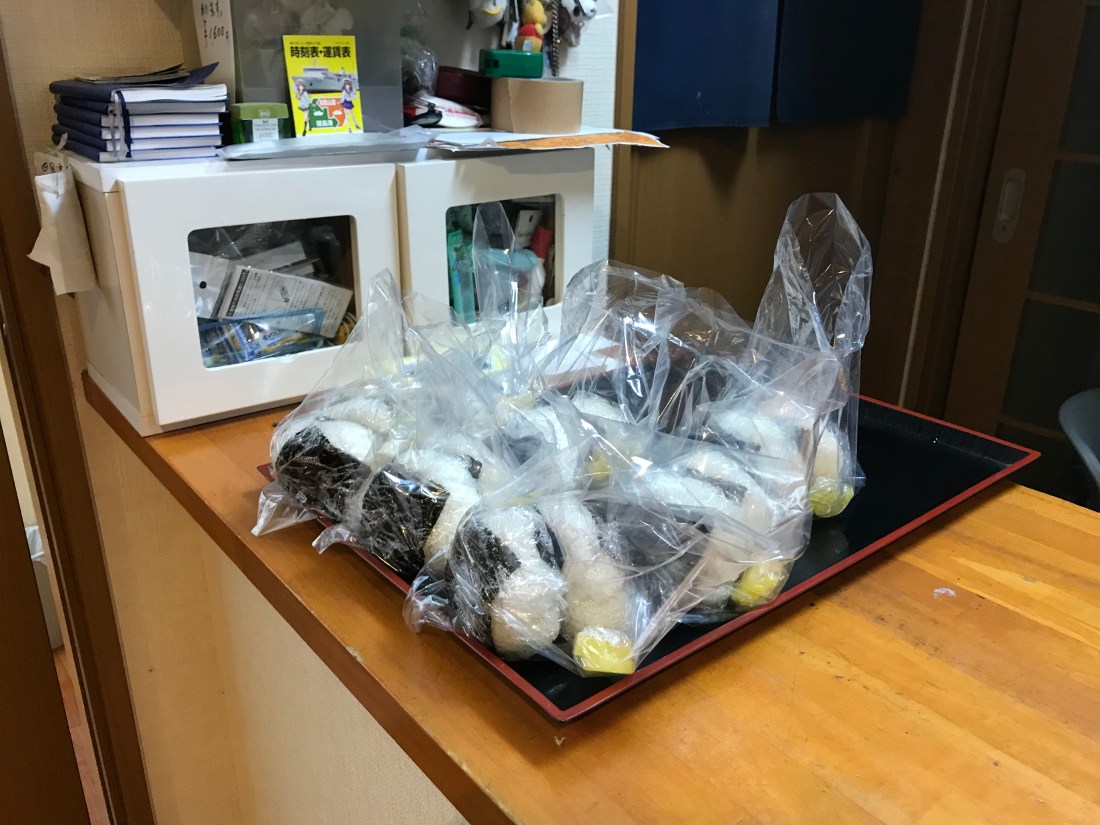
At Ryokan Yoshino, I had sat around for a few minutes thanking the woman who made our dinner and breakfast. She also made nigiri, Japanese rice balls, one with a pickled plum and the other with seaweed, for the people who were hiking the mountain. The rice balls reminded me of my grandmother’s cooking. In any case, I explained that I took a taxi to the ryokan because of the late hour. A round of Aso came forth – aso translated to, “As you will.” I include a photos of the owner of Ryokan Yoshino and the nigiri left on the counter to picked up.

What a rich day of seeing beauty, of engaging in Japanese, and of feeling the good nature of people.

Day 5: From East to West, North to South in the Tokushima Valley (8 March 2019)

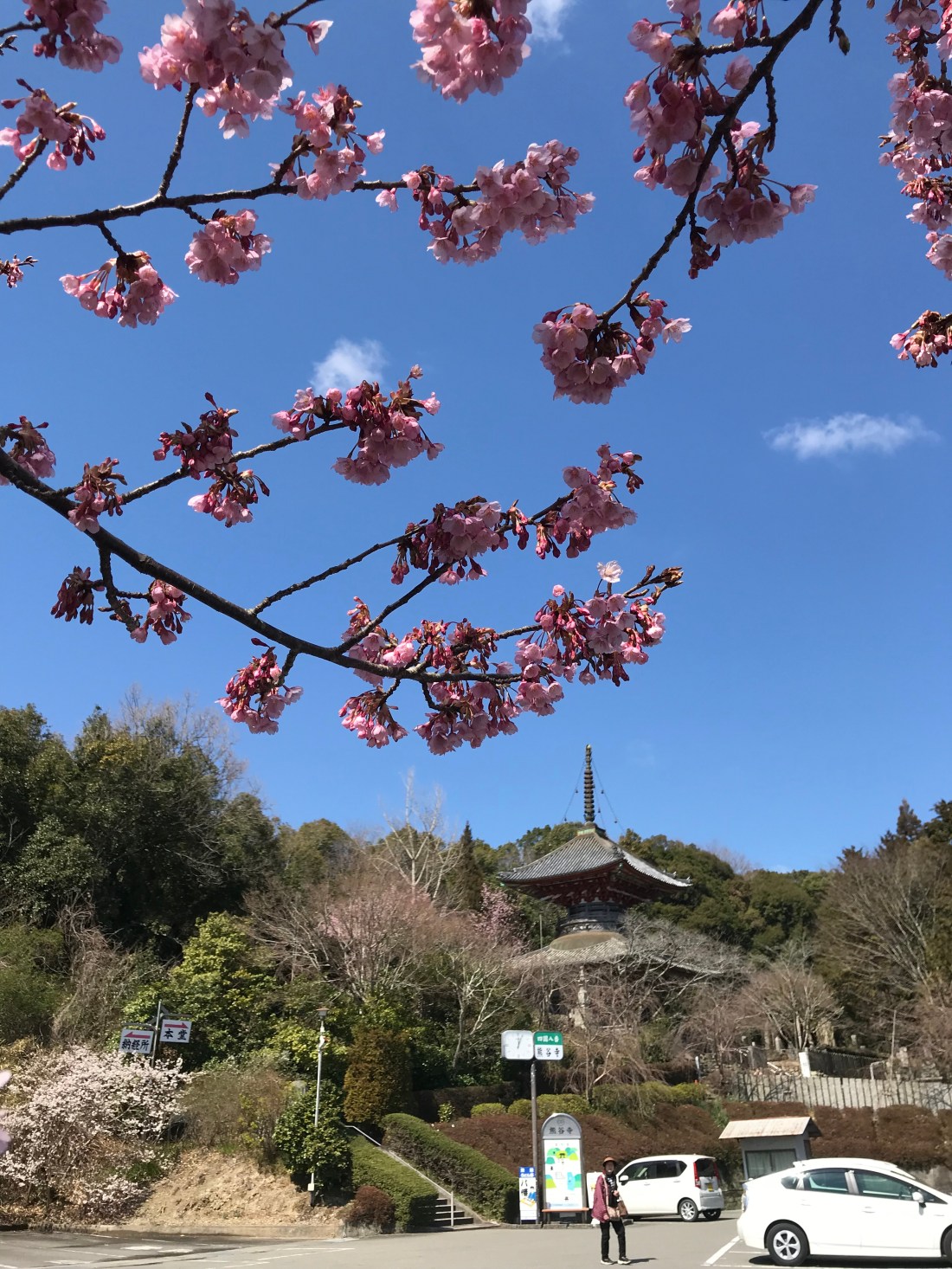
The sky was Carolina blue and warm enough that cherry blossoms could be seen in spots throughout the valley. The most concentrated group of blooms (Sakura) were the trees around Temple 9 which face south. Photographers were out and about capturing images. According to this evening’s newscast on the national channel, the blooms were two weeks early. Here are some photos from around Temple 9. Surely Tokushima is having better weather than Pennsylvania. The groundhog missed his mark — big time; alas, like every other weather person, no consequences. For the record, I am not the photographer in the first photo.
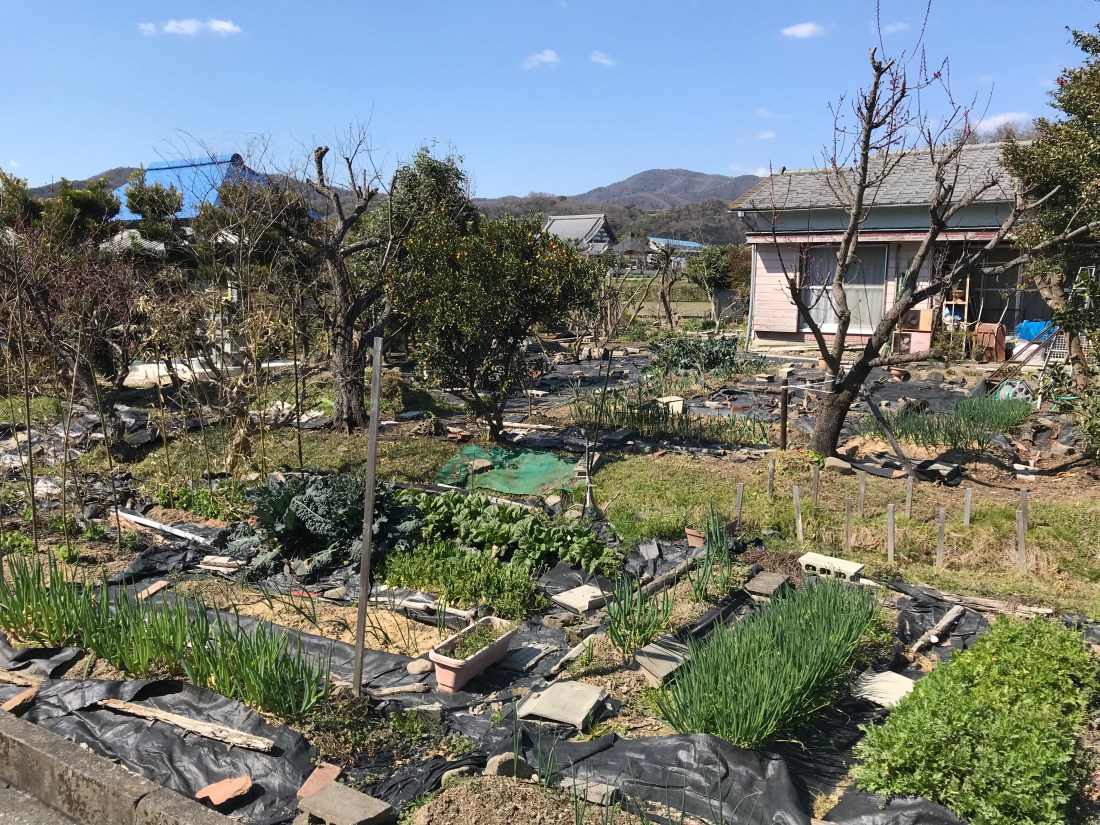
The walk provides plenty of time to reflect and enjoy the environment, specifically gardens. I have come upon wonderful examples from highly manicured to seemingly very natural gardens. Common to all of them is the absence of grass lawns. Rather, gardens are filled with trees and perennials or are planted with seasonal vegetables and fruit trees, I have contended that grass lawns are one of humankind’s worst land uses – wasted person hours cutting grass and the overuse of pesticides and herbicides. Perhaps we can learn from these examples.

As of this evening (a woman graciously drove me the final half mile to my ryokan – I was one hill off), I have walked from Temple 1 to almost Temple 11 from East to West and from North to South of the Tokushima Valley. I reached the vicinity of Temple 11 where my ryokan is located around 5 PM, closing time. I’ll visit Temple 11 tomorrow before hiking what is said to be the most challenging segment of the 88. However, today’s 18 miles got to be pretty long in the tooth by the end. Thank you to the Good Samaritan or should I say the Good Buddhist who helped a pilgrim in need. I wanted my bath before dinner and an Extra Dry Asahi beer.

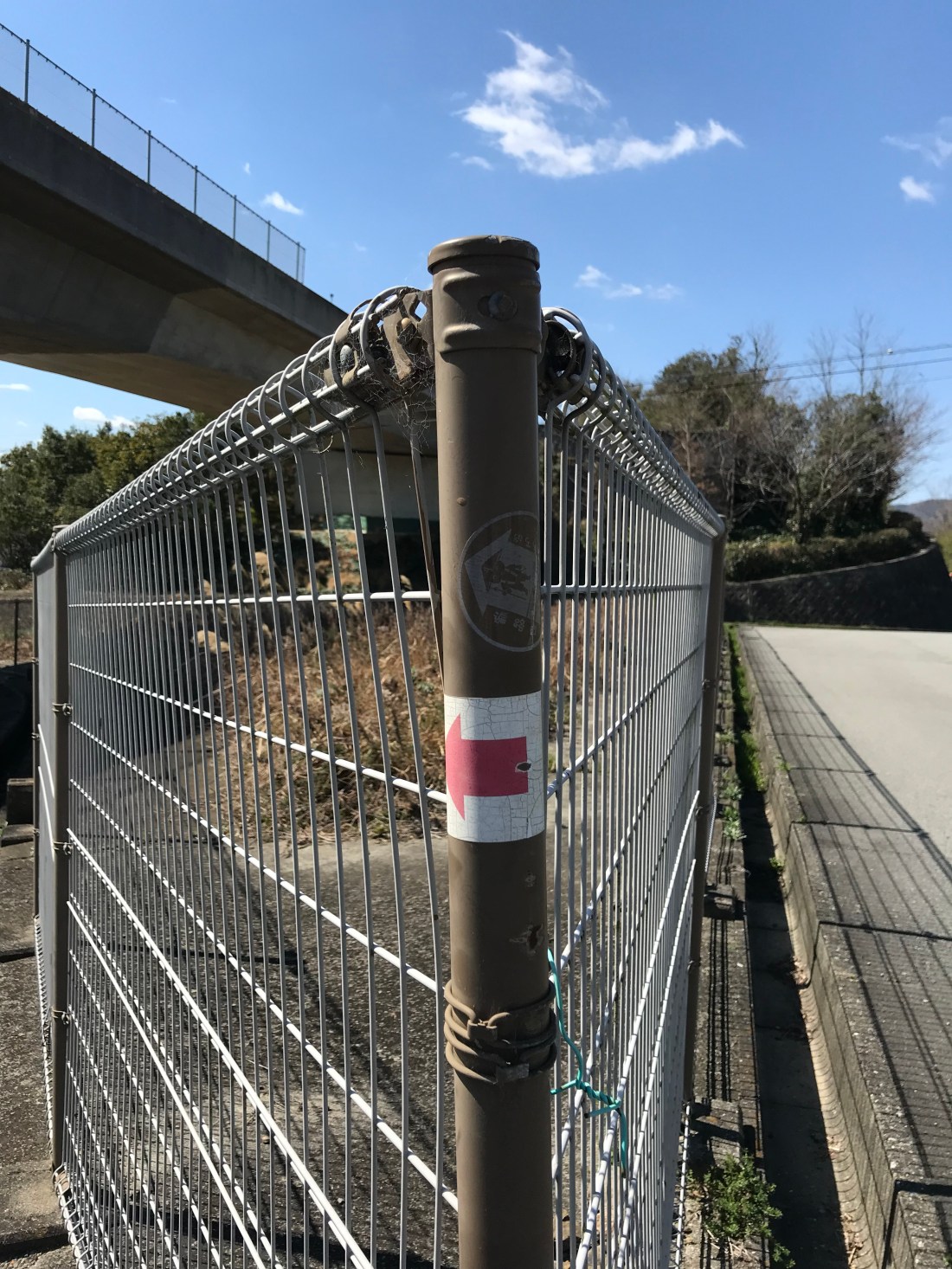
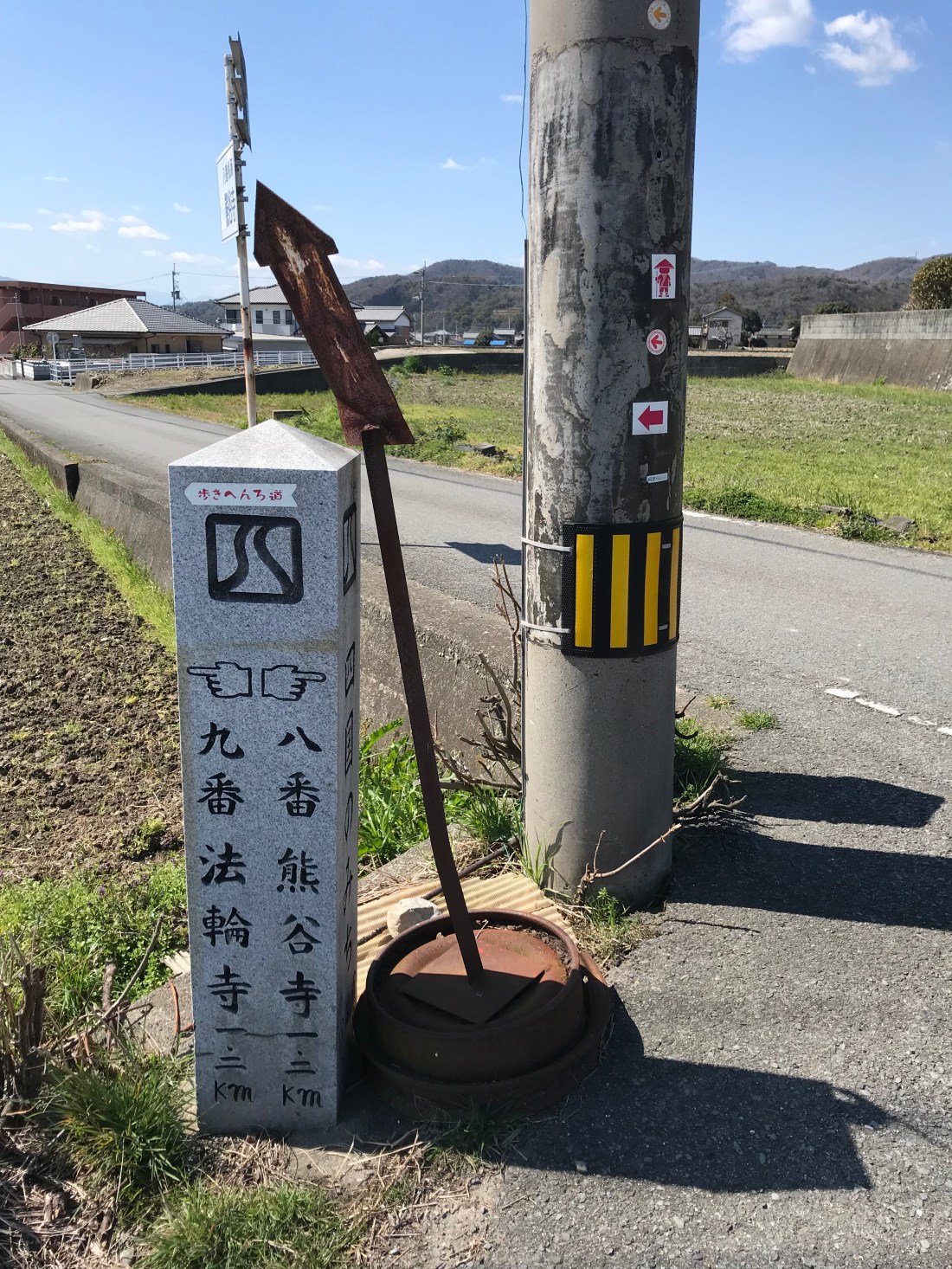
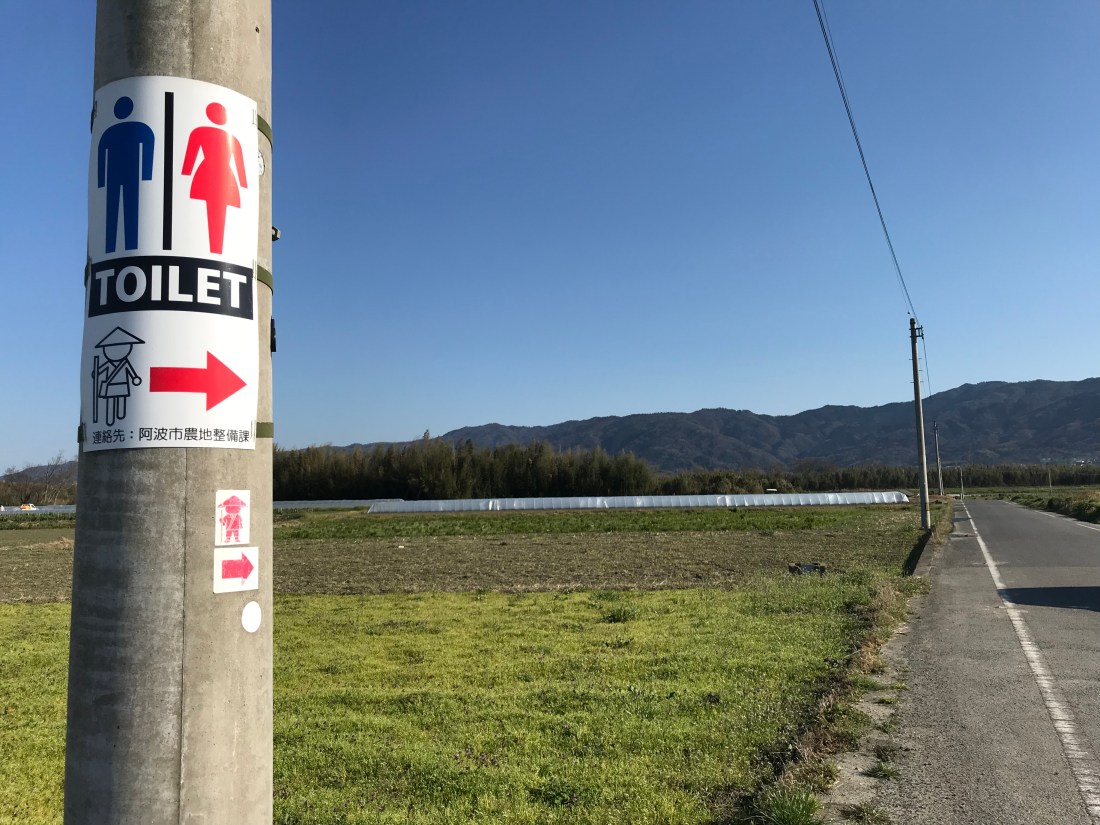
Besides having a superb set of maps from my 2018 guidebook (totally accurate from roads — no Waze for the walker — to noting important services like accommodations, 7-11s, and toilet facilities), the henro association has marked the path with elegant as well as barely noticeable signs. One has to keep looking for these signs at critical junctions and intersections while enjoying the view in order to stay on course. Missing one may be costly to the wear and tear on the body. Here are some examples. Thank you from a grateful henro.

Day 4: A Pilgrim Learns a Lesson (7 March 2019)

Bandō Station. The beginning. Walking up two blocks, I turned to the left following my map. But there it was like Dorothy’ Yellow Brick Road, the Green Line marking the way to Temple 1.

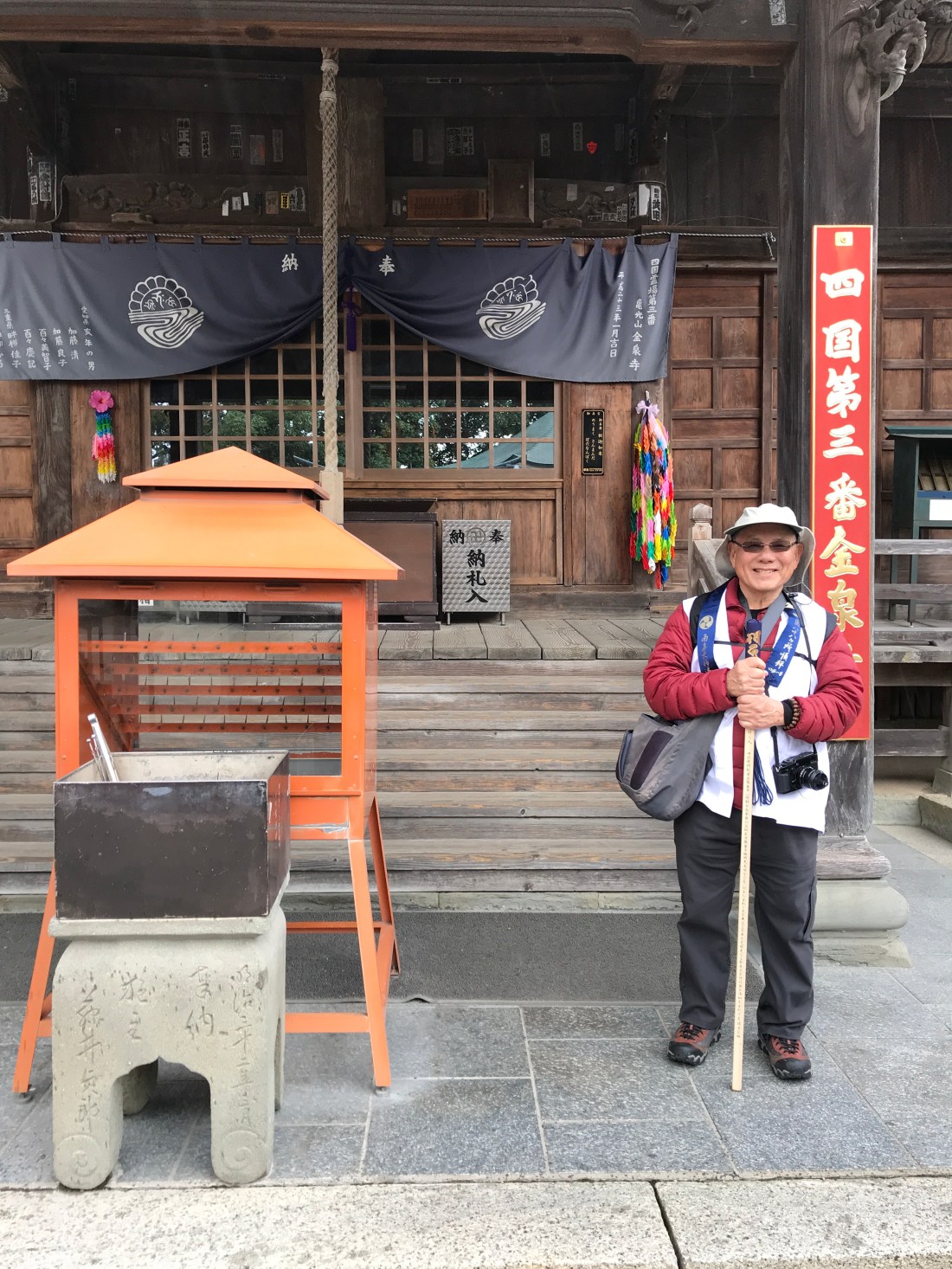
After buying my henro clothing and signature book, I went outside of the shop to put on my vest and prayer stole. It was an odd moment. I felt that I was in a uniform separating me from others. At Temple 1, I was the only one in uniform. But soon that feeling abated. I met others wearing white, all with the pilgrim’s stole, almost all walking with ritual staff. Here I am at Temple 3.

Even though I had carefully planned what I would bring, I ended up carrying more than expected. Now I had more clothing items and a book to protect from the elements.

Just after this photo was taken, the heavens broke pouring rain. Yesterday, I had bought an umbrella adding to my burden. As I walked along, I kept thing, what can I toss? Ah, maybe some of the blister items to create space. I had a package of blister prevention tape, adhesive pads in case one developed a blister, and even an applicator that promised to help prevent foot and shoe friction. Why did I go to such lengths?

As I walked up the hill to Temple 4, I stopped at a cemetery to rest. I knew at that point that the balls of my feet were in blister production mode. I tried to will them away but to no avail. With four miles to go, I had to gingerly take my steps.

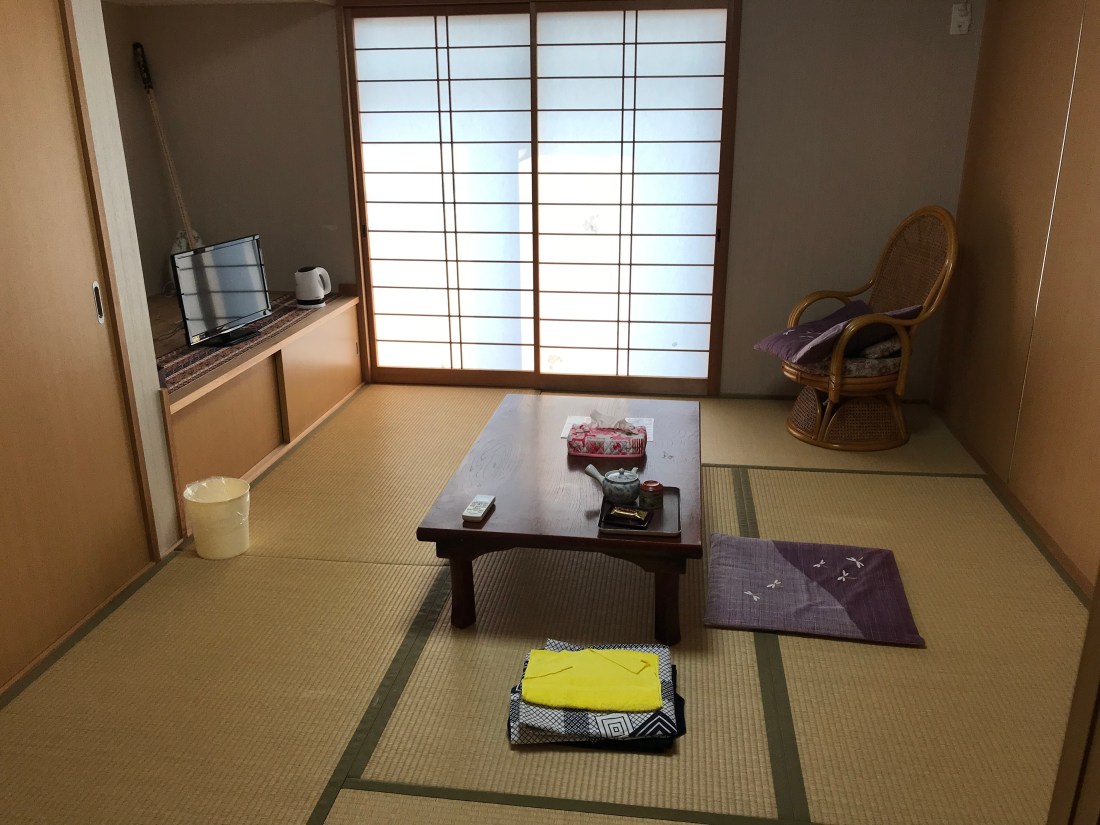
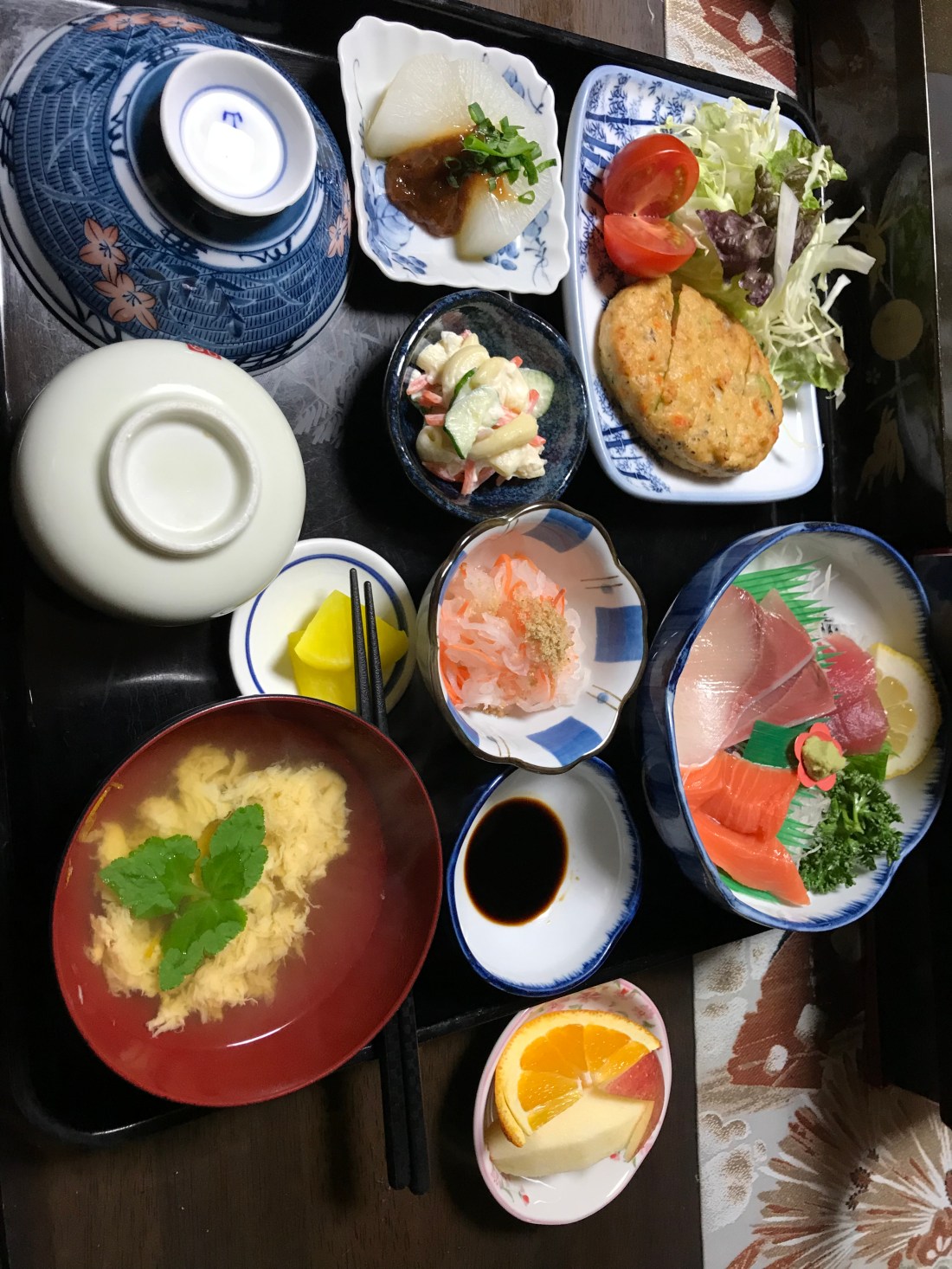
My inn was next to Temple 5, thank goodness. The bath was divine for tired muscles and feet. Then, the blister pack was opened. We’ll see how the feet survive a 14 mile today. Lesson: Don’t fret or worry. Just enjoy the walk. It won’t do you any good. I am going to keep everything for the moment. Photos of my room and dinner at the inn are below.

Although the temples have common structures (entrance with bell nearby; water to wash your hands; the hondo, main hall; a statue of Gobo Daishi; and signature obtaining office), each are laid out differently depending on theme and geography. Temple 2 is dedicated to help women in childbirth. Temple 5 served warriors. As I walked through the temples, their inner peace consumed me as I wandered about – the ultimate “go with flow.” Some specific objects were stunning like the rock at the entrance to Temple 4 – never had I seen a rock 10 feet tall with contours that portrayed the mountains as this one and the 800 year old ginkgo tree in the courtyard of Temple 5. More wonders to come.

Almost time to arise for today’s walk from Temple 5 to Temple 11. The gentle snoring from the adjacent room reminds me the we are alive and well.

Day 3: The Prelude Is Almost Over (6 March 2019)

I have reached Takamatsu, the city that is my staging stop. Tomorrow, to Bando Station, followed by a short walk to Temple 1 to begin the pilgrimage.

These past few days have given me the opportunity to absorb the jet lag though I am far from being over its effects. Although I thought that I was an eight old in Japanese, a more realistic assessment puts me at a six year old with a few more “mature” words. Nevertheless, I can check into a hotel, get a train ticket, and order dinner using Japanese. I am certainly better off than I was 14 months ago.

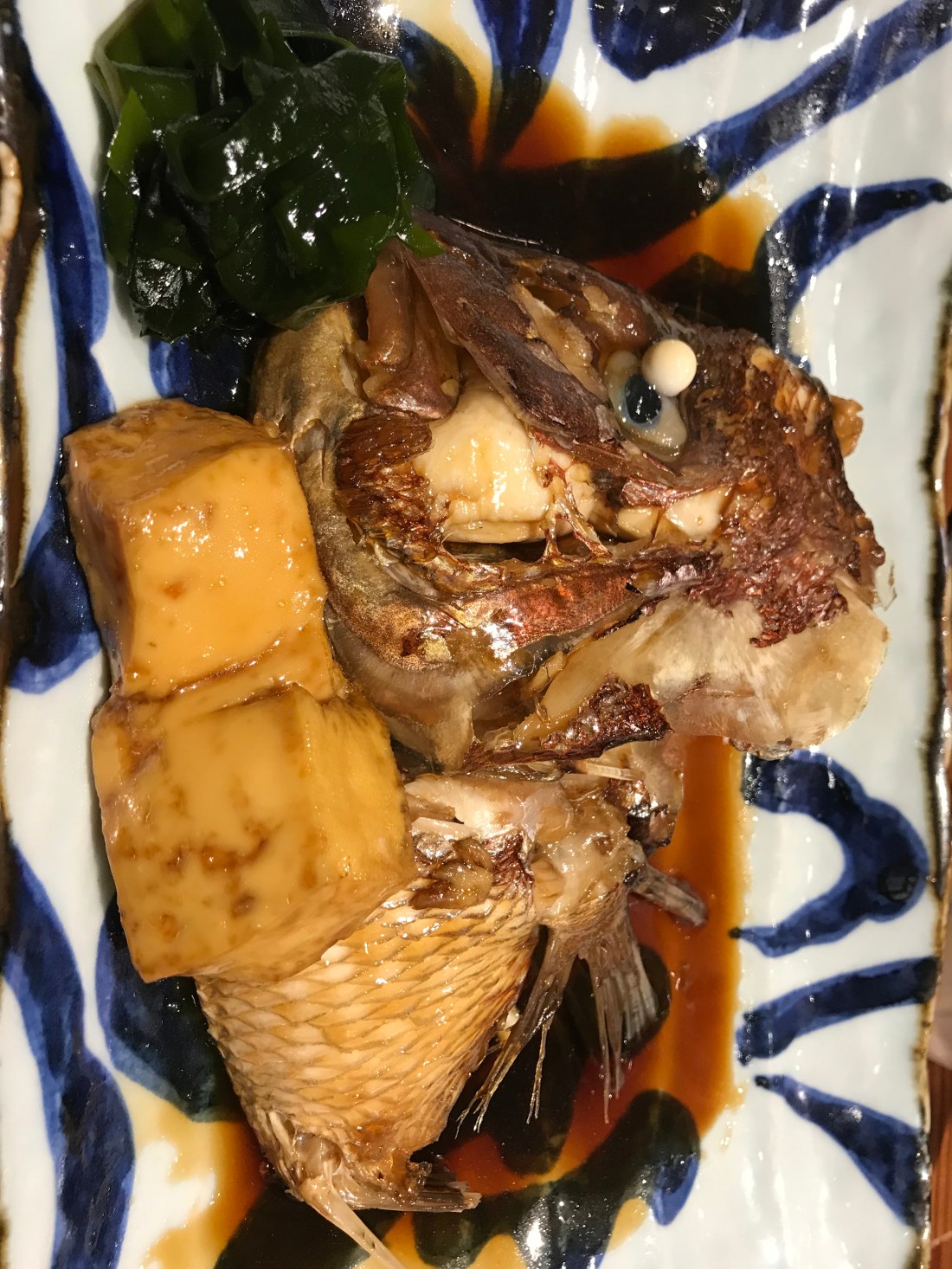
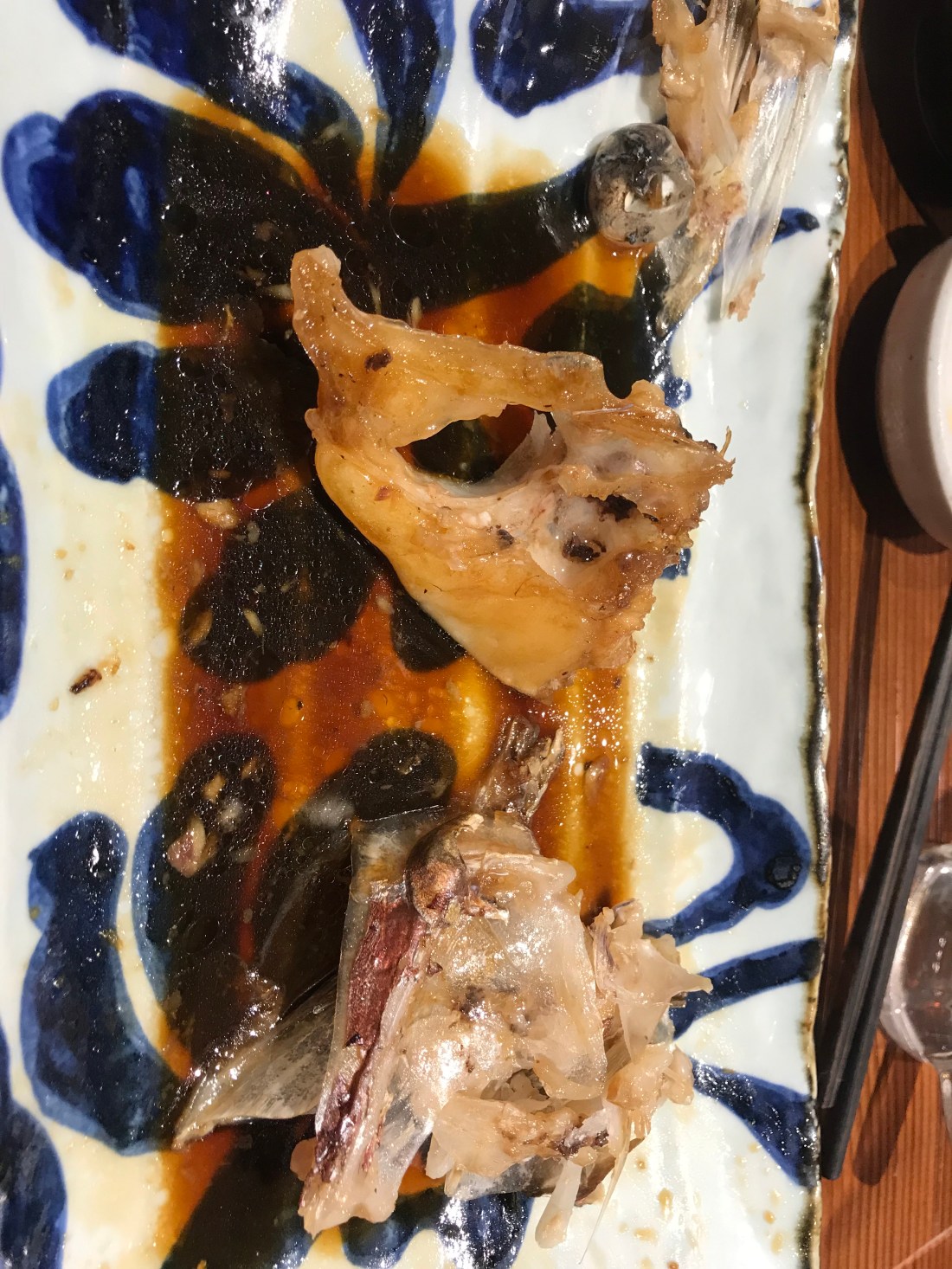
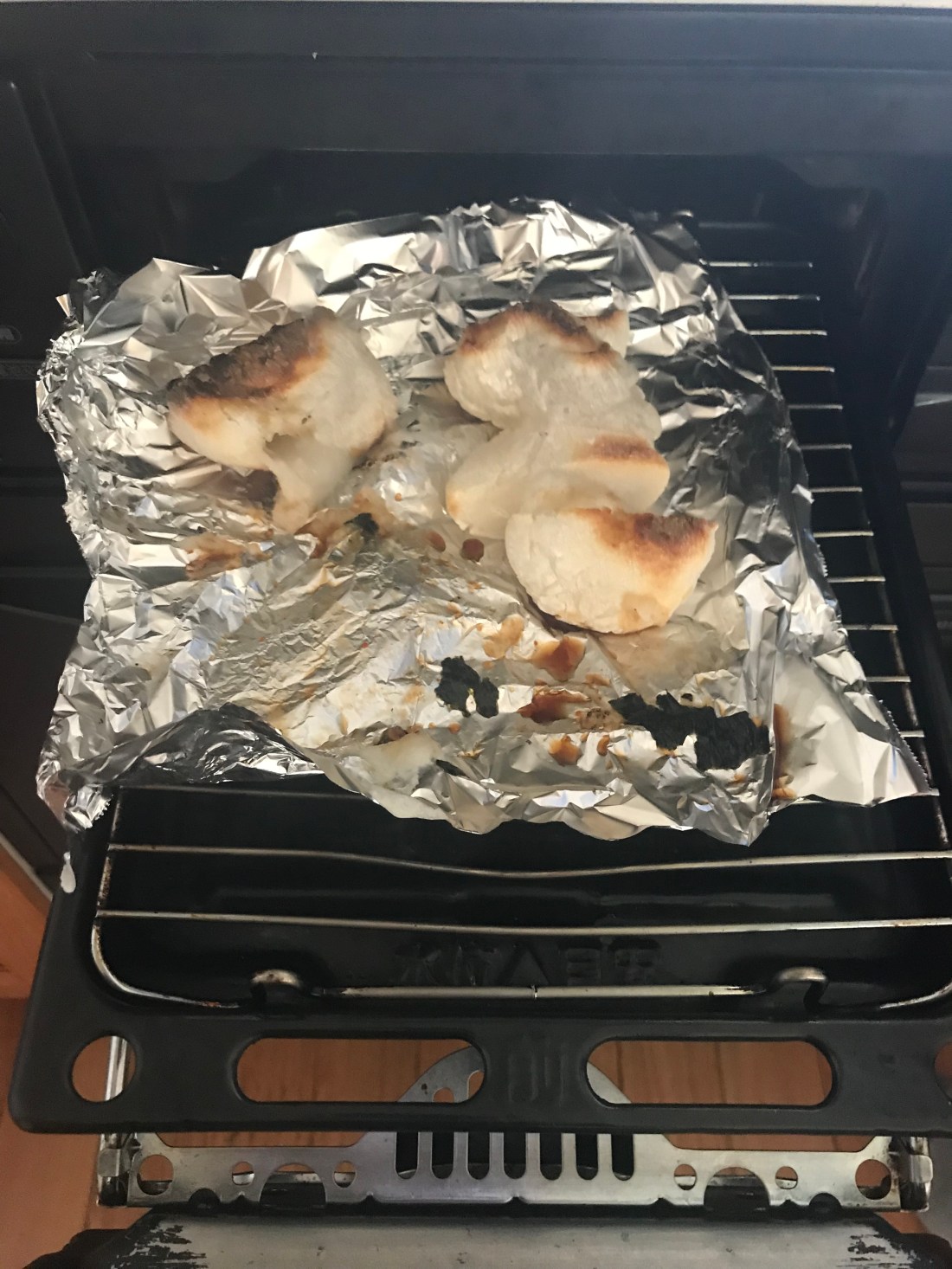
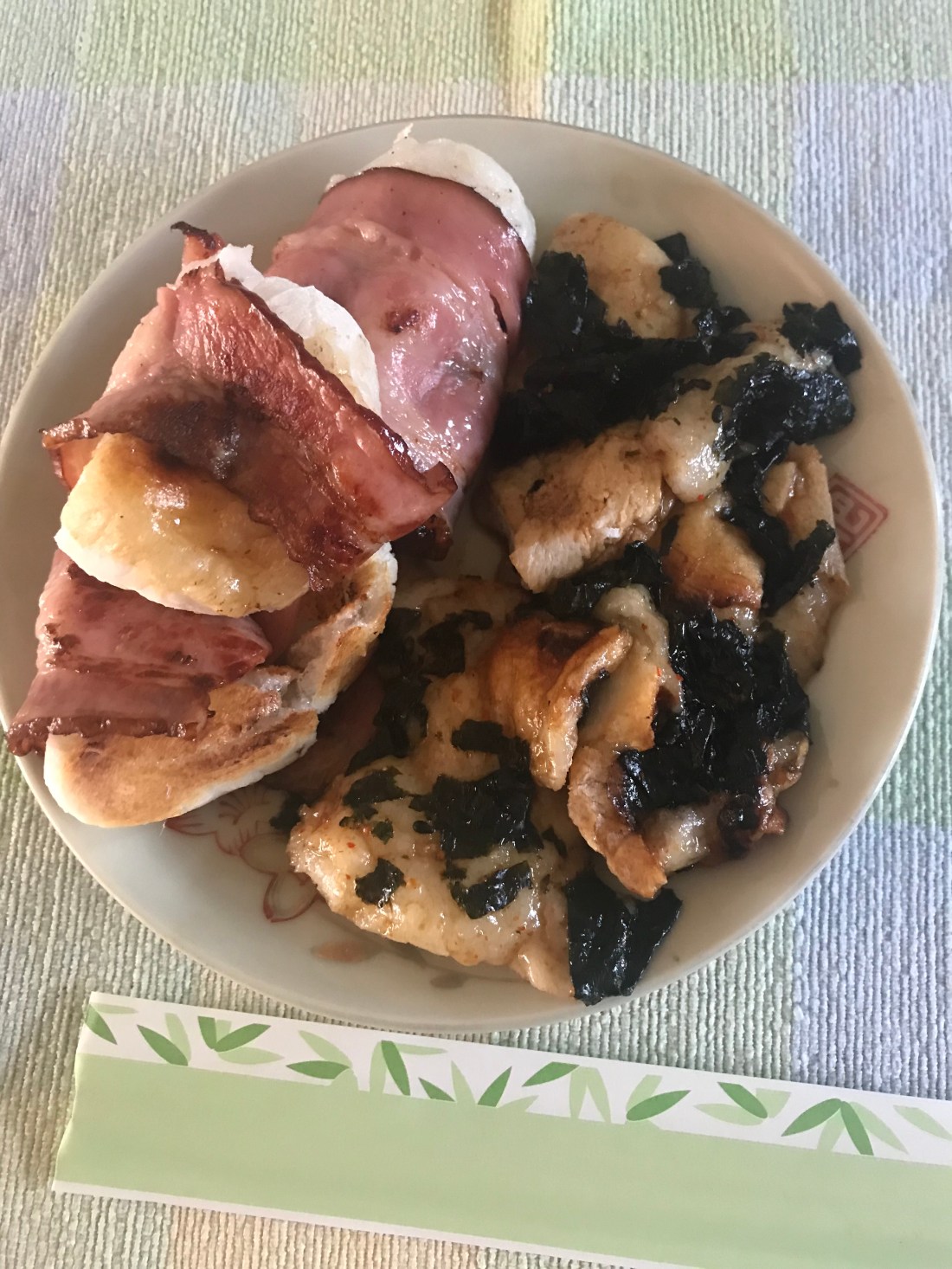
I was looking forward to dining on Japanese food for the entire trip. I can report that I am off to a good start. How about the before and after photos of a grilled red snapper’s (tai) head and tail. My father would have enjoyed this fish and most likely would have cleaned it better than I did. I even ate broiled mochi like my mother used to make. I did not care much for it back then (really not at all) but Fukiko’s style of bathing it in a nori sauce and wrapping pieces in bacon was delicious.

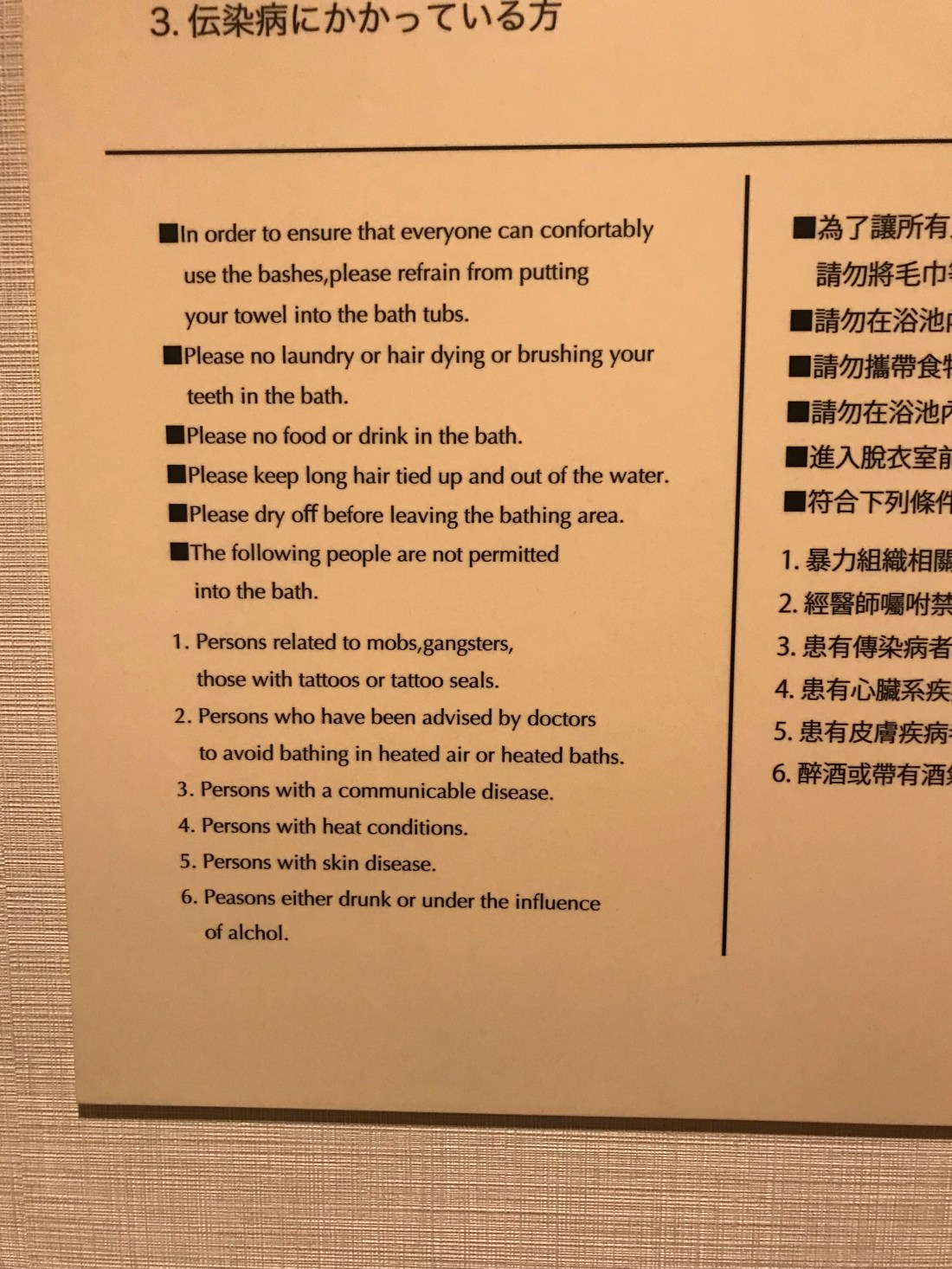
I also included a photo from the entrance to the public bath on the top floor of the hotel. I am always amused by signs in other countries. I was glad the I did not meet any of the criteria for being barred from using the bath. No gangsters in my family.

Tomorrow begins this trip in earnest. Phase 1, Tokushima province, is the Place of Spiritual Awakening. The legs will indeed be awakened especially after Day 6 with a cumulative climb of 3500 feet and Day 7, the first 15 mile day (heavy rains are predicted making it a particularly exciting day). It’s raining now but the only path is forward.

Tai as presented in its before state.

Tai in its final state.

Mochi under the broiler just like mom.

Mochi covered in nori sauce and wrapped in bacon

No gangsters welcomed.

Day 1: A Pilgrim Lands in Japan (4 March 2019)

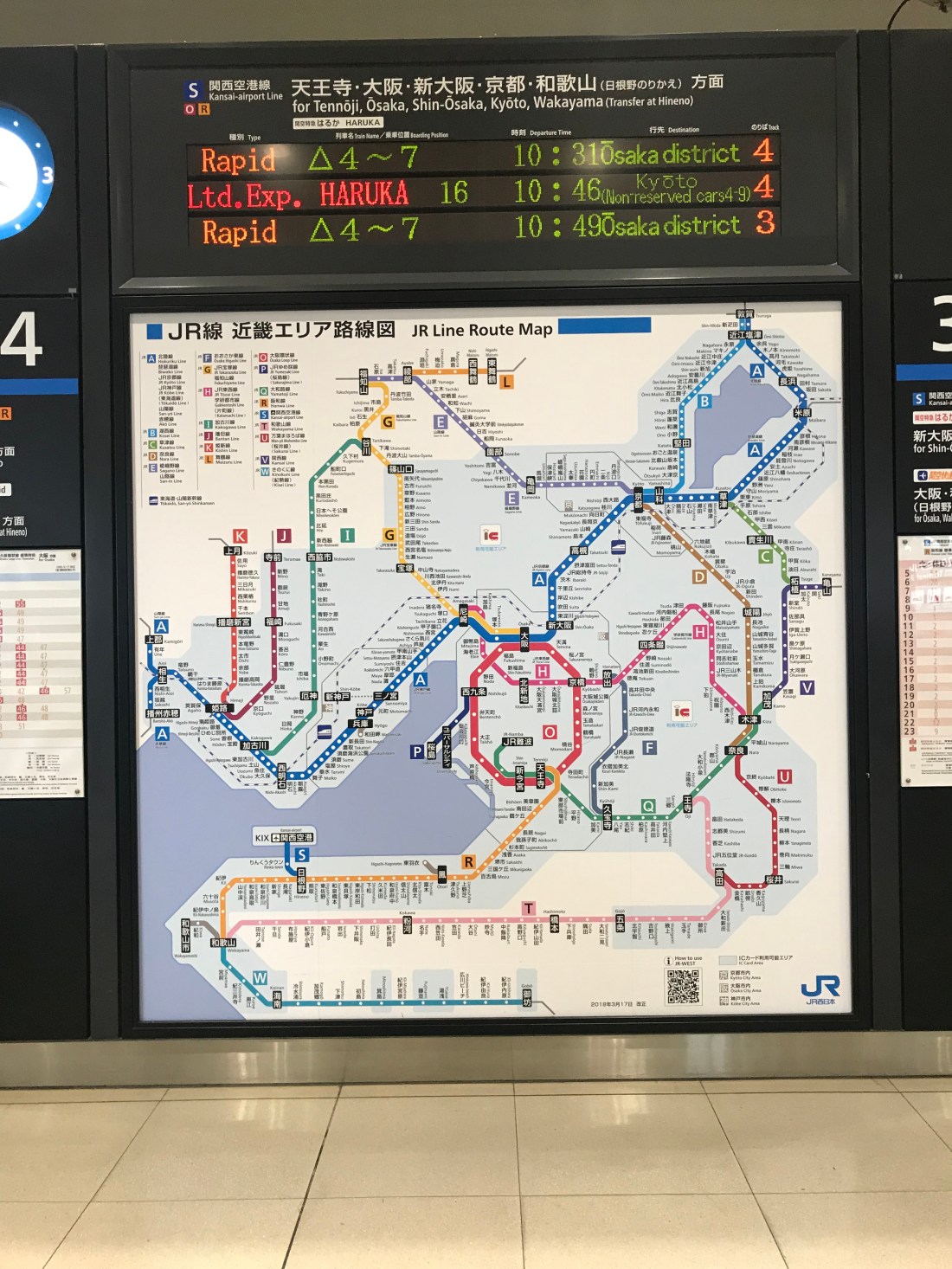
After 19 hours of flying time, I touched down at Kansai Airport. KIX, its airplane code, is located on a man made island about 30 miles south of Osaka Japan Rails (JR) station. If you are a train enthusiast, Japan is the place for you. Photos of the Lufthansa flight at the moment of landing and the JR map of the Kansai region (Osaka, Kyoto, Kobe, Okayama, and Wakayama) are provided below. I boarded the 10:46 Haruka for Kyoto.

As I may have mentioned, you can easily obtain Japanese currency by using the ATM at the post office office or 7-11 (you’ll recognize the sign) on the 2nd floor of Terminal 1. No need to get currency before coming.

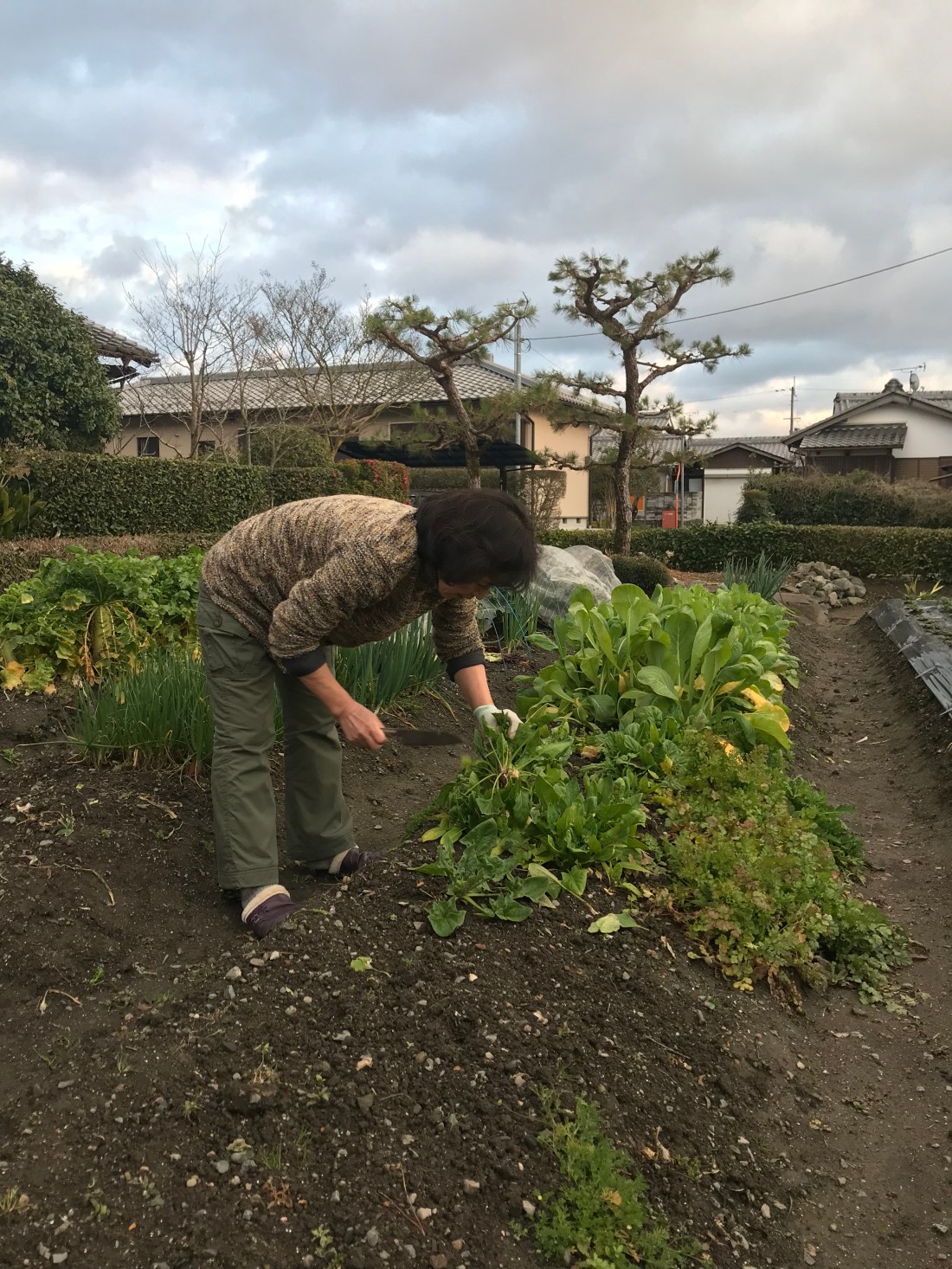
Fukiko met me at the Kameoka train station. She made lunch and dinner which included scallions and spinach from her own garden – that is farm to table! That’s Fukiko digging up spinach from her garden.

Her home has been in her family for several generations. When her parents died, she came “home” to live in order that the home remained in family hands. She will pass along this home to her daughter who lives in Germany. If her daughter decides not to return to Japan, Fukiko’s brother’s son has promised to move his family here. She indeed puts life into the phrase, a house is not a home. I wonder how many of us feel this way.

In between lunch ( a hot bowl of sunuki udon, chicken, an egg, topped with Fukiko’s scallions) and dinner (teriyaki tuna, crab and seaweed salad, spinach mixed with sesame – just like my grandmother’s), we went over the koseki of my grandmother’s and grandfather’s family. See the photo of dinner below. 80 more days of this cuisine! Fukiko is holding a lacquer cup with sake brewed in her village – delicious at room temperature.

I felt like a guest on Henry Louis Gates’s Finding Your Roots program. The Yanai City Hall provided two separate records, each three pages long. One record was of my grandmother’s family and the other of my grandfather’s. The connection between the two was, of course, my grandparents, both with the family name Kuniyuki. In a population of 110 million Japanese, only 420 families currently have this last name with most living in Yamaguchi, southern Honshu, and Kagawa, one of the four prefectures of Shikoku. Takamatsu where I will be going tomorrow is the capital of Kagawa.

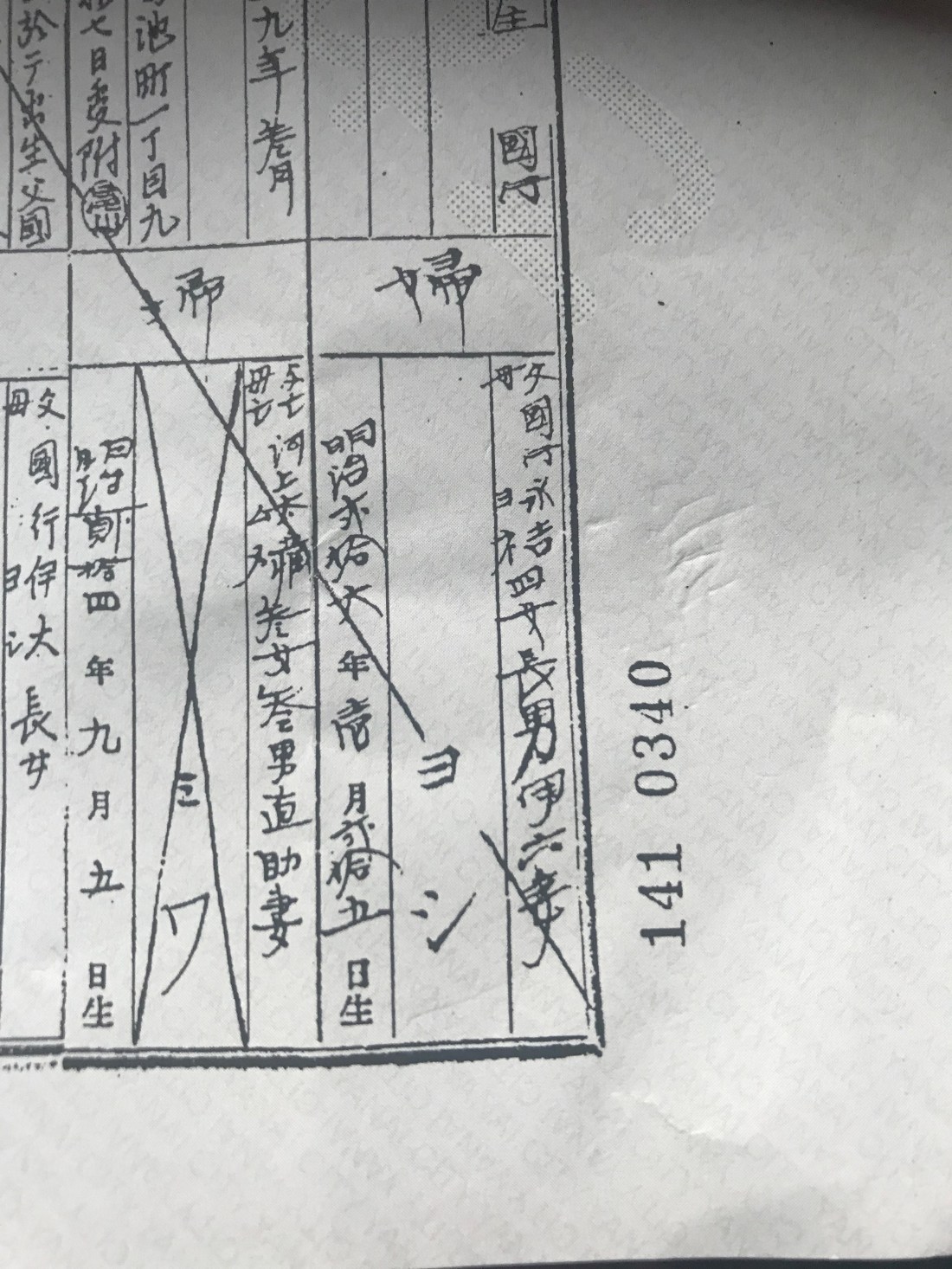
Yoshi, my maternal grandmother, was the fourth daughter and the youngest of seven children. Iroku, my grandfather, was the first born son in a family of seven. His brother, Tomozuchi, who migrated to the US and known to my sister and me, was the fourth son and youngest in his family. Another surprise was that my mother is recorded in this koseki meaning that she was a Japanese citizen! I had no indeed because my grandparents never wanted to talk about the past. The kosekis only went back as far as 1830, the birth year of my maternal second great grandfather (Kuniyuki Dikki-zo) who relocated from Kobe.

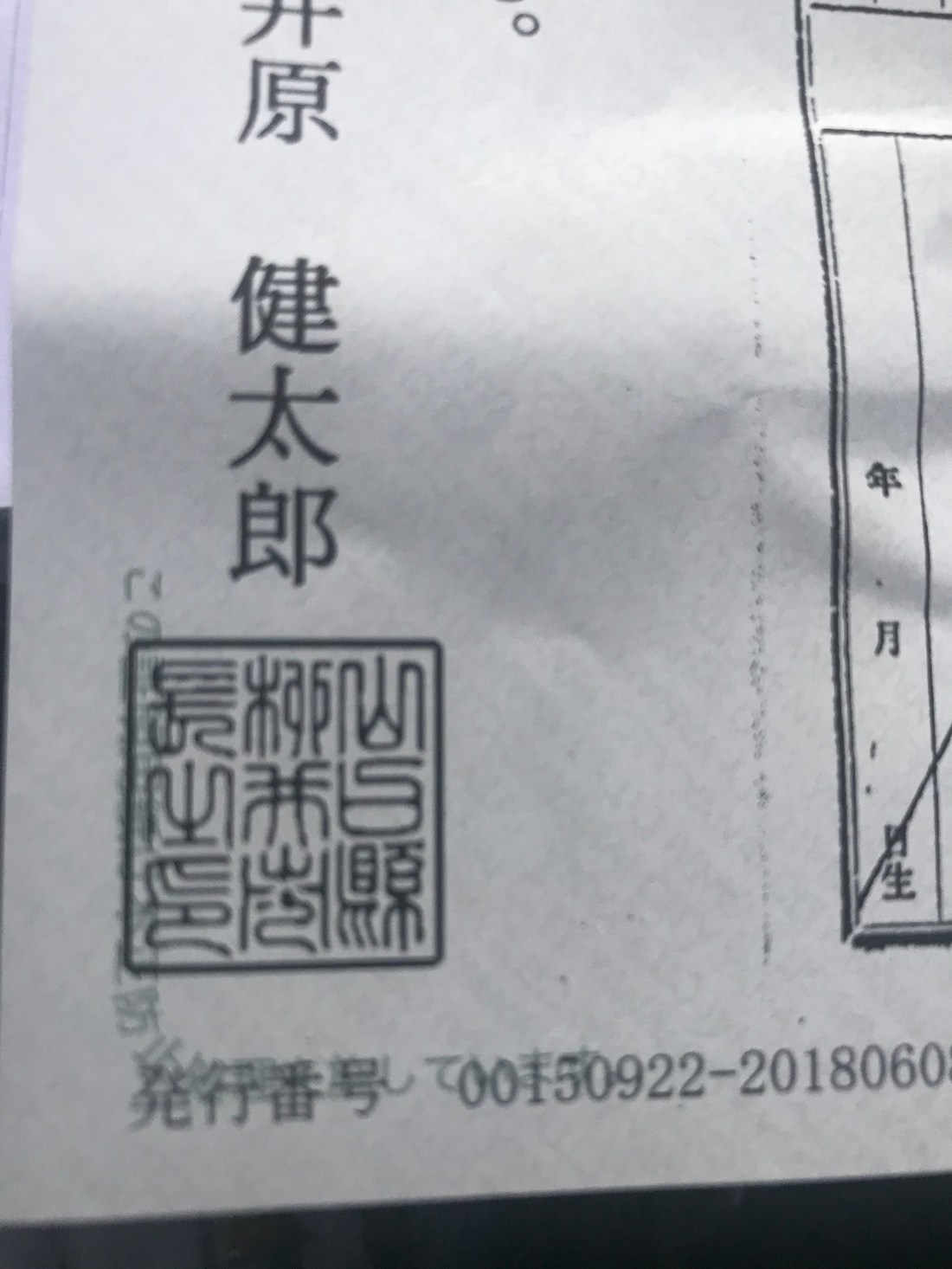
Without more information, we could not determine how closely related my grandparents were. Was my grandmother’s father (Kuniyuki A-kichi, born in 1852, son of Dikki-zo) a cousin of my grandfather’s father (Kuniyuki Tamizo, born in 1861) but whose father is not recorded? A mystery for further search when to travel to Yanai on 16 May. Besides finding my grandmother’s home, I plan on staying a few days to visit our families’ gravesites and to get a feel of the city. I included a close up of my grandfather’s, grandmother’s, and mother’s entries along with the Hanko (official seal) of Yanai City.

What remarkable and courageous people to have left their families for America. I am humbled and honored to walk in their footsteps and make the pilgrimage.

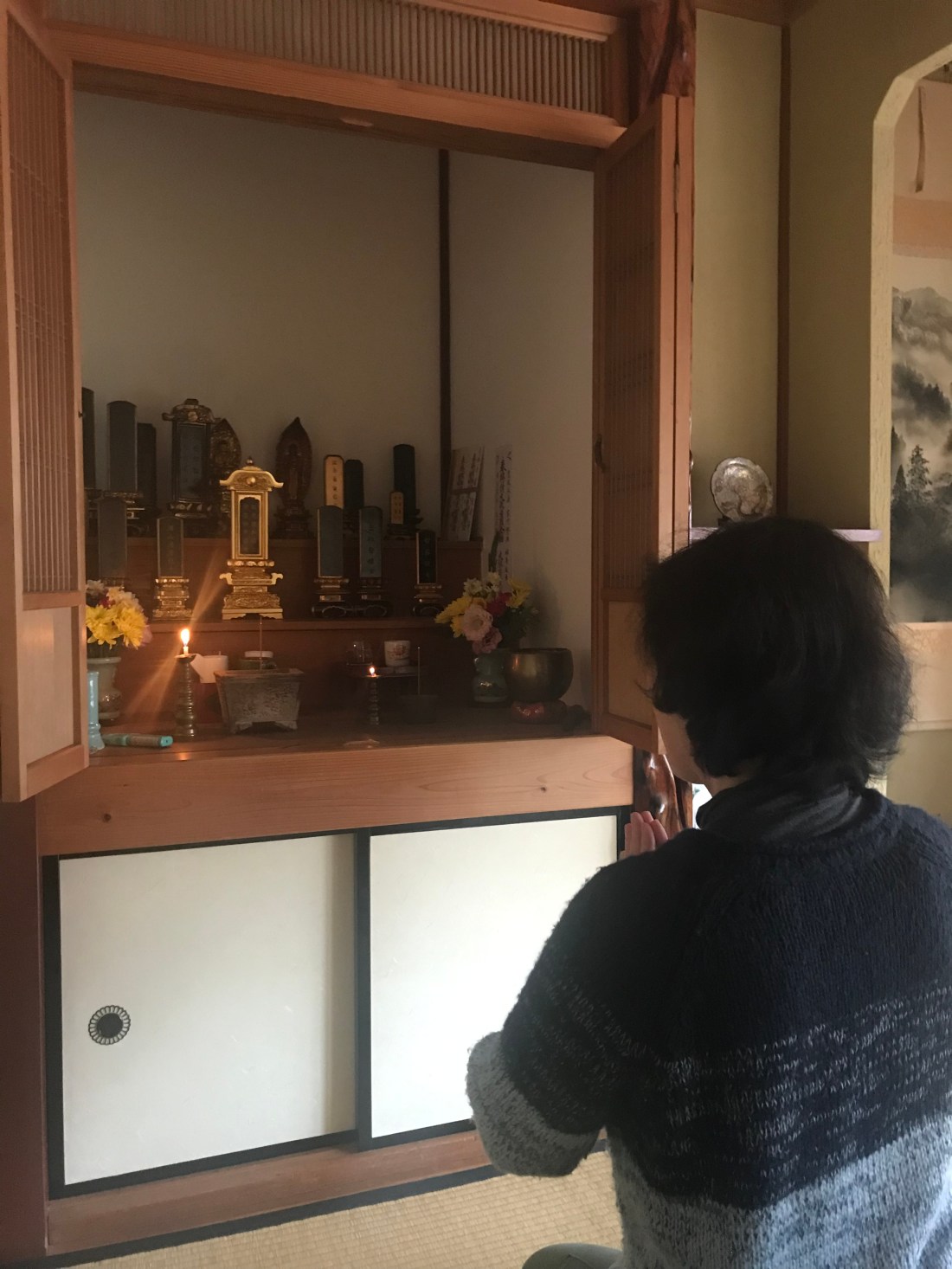
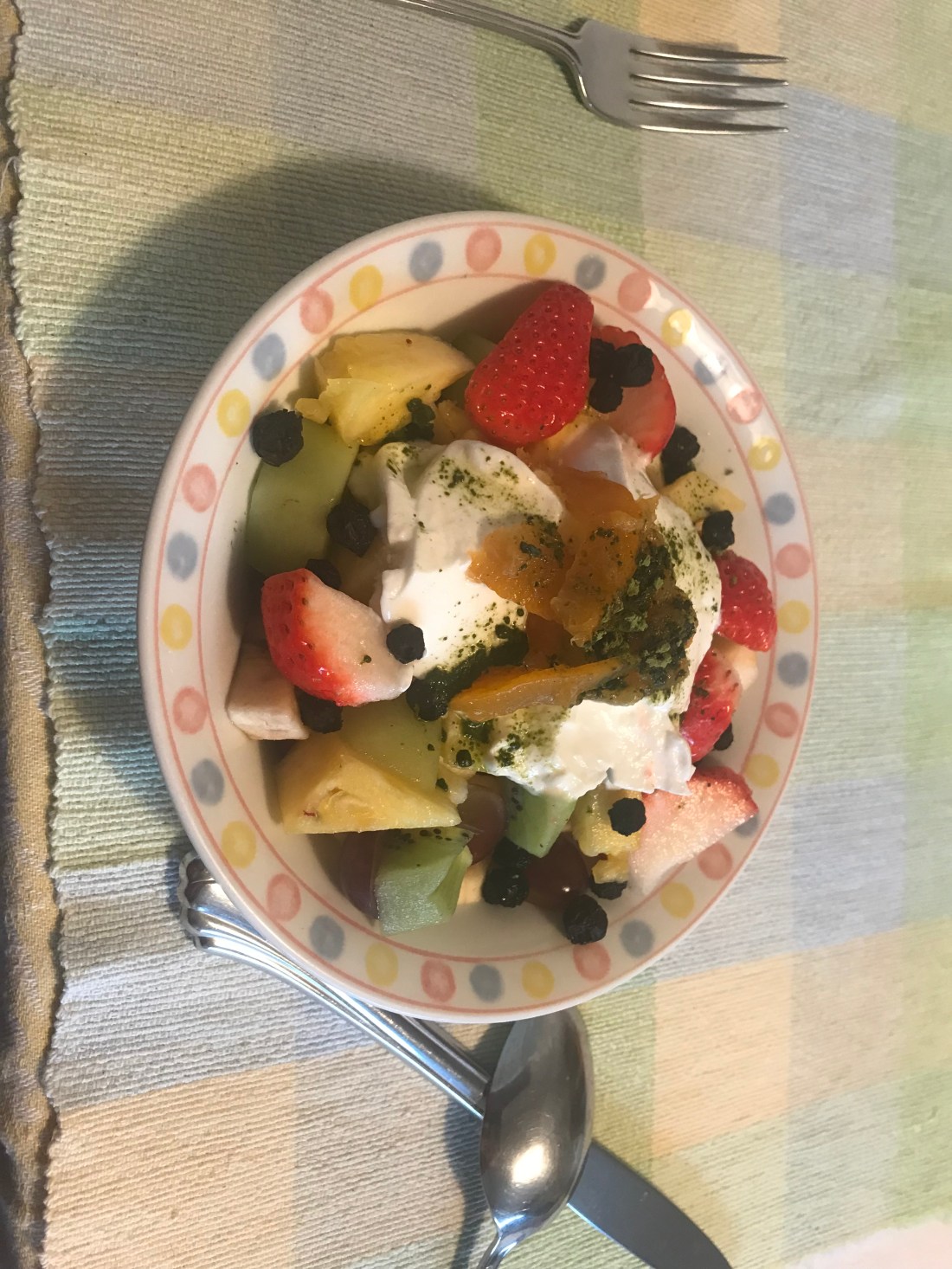
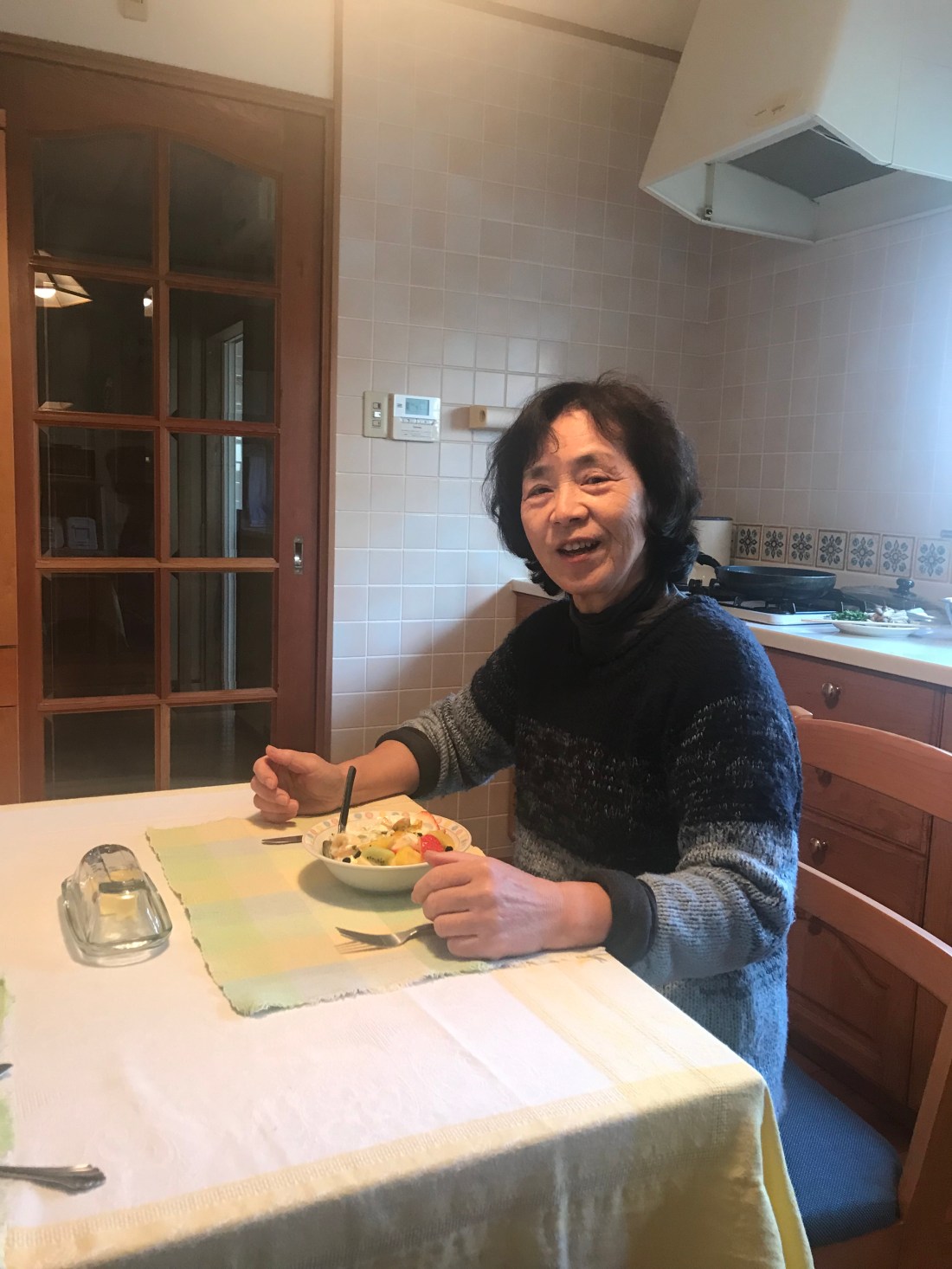
This morning before breakfast, Fukiko invited me to pray at her family’s shrine – a daily ritual in traditional Japanese families. Afterwards breakfast started with a fruit salad topped with homemade yogurt, dried orange peels and blueberries. Voila, a photo of Fukiko.

Stay tuned. Off to Takamatsu tomorrow morning.

T Minus 3: 27 February 2019

Three days before setting off on my 88 Temple journey on Shikoku Island.  If you want to see and read more about this pilgrimage, type in “88 Temples” on your browser.  Many links will appear.  Particularly helpful is the one for the PBS documentary on the pilgrimage.

Why am I doing this walk?  I have known about this walk for about five years.  The catalyst for deciding to commit to the journey occurred in November 2017 when Sharon and I were on a bus leaving Koya-San, the temple complex founded by Gobo Daishi who is the patron of the pilgrimage, in Wakayama Prefecture.  We met a 40 year old Australian policeman who had just completed the pilgrimage and his visit to Koya-san.  I asked him, “What effect did this journey have on him?” He said that the pilgrimage “restored his faith in mankind.”  About a week later, I said to Sharon that I wanted to make the pilgrimage starting in March 2019.  I have planned to complete the pilgrimage in 60 days plus 10 (the extra 10 for days when I am tired, ill, or wanting to wander around an especially beautiful area).  If all goes according to my general plan, I should complete the journey on 14 May, my father’s birthday.
I will then have 13 days in order to visit my maternal grandparents hometown, Yanai City, Yamaguchi-ken and perhaps other areas of Japan.  My maternal grandmother left her village in 1915 and arrived at Seattle.  She married my grandfather three days later.  With her passport in hand, her marriage certificate, my mother’s birth certificate, my mother’s marriage certificate, and my birth certificate, I was able to secure my grandmother’s koseki, her entire family history from the Yanai City archives.  My contact in Japan will have translated the koseki.  She will give me that document when I arrive at her home.  Sharon and I had a homestay with her on our last visit to Japan.  With the koseki in hand, I will travel to Yanai City where a member of the city staff will take me to the address given on my grandmother’s 1915 passport.  Who knows what physical structure if any will be on the site.  Regardless, I will stand on the grounds where my grandmother lived and left when she came to America as a 22 year old woman.

The reasons for making this journey run deeper than the snap decision of December 2017.  I have mentioned to some of you that I have only two regrets in my life: not learning Japanese, and declining to go on junior year abroad in 1968-69 to Waseda University in Tokyo.  I often think about what my life would have been like if I gone to Japan at that time.  What would I have become if I had chosen the other road as Frost wrote?

For years, I have felt awkward in knowing that I am Japanese by origin and looks yet not being comfortable to speak Japanese and to be around Japanese people.  According to my mother, I spoke only Japanese until I was five.  Then, regular American schooling ensued.  My parents did send me to Japanese language school on Saturdays.  I was a total failure.  I wasn’t interested in learning the language; baseball and playing with friends were higher priorities.  I must add though that the school served native Japanese speakers and thus those of us English speakers were literally placed at the back of the bus.

My first trip to Japan was in 2004; Sharon made the trip before me a month after 9/11.  My Japanese was almost non-existent.  I did discover that I could read most of the kata-kanaand hiraganacharacters.  We spent 12 of 14 days in Kyoto experiencing a city that has 20 World Heritage sites. Kyoto is Sharon’s favorite city in the world; it is my second favorite.

I returned a few years later to Tokyo as a member of a school accreditation team.  Remember — my spoken Japanese was almost nil. The awkward moment came when the chair of team, who was white but who had spent over 30 years in Japan, explained in Japanese to the head of school, that I was an American, third generation (Sansei).  The head of the school nodded with the universally known phrase, A-so desu after exhaling the sound, huh.  It is hard to write out what that sound is but it is not honorific.

Then came my third trip in November 2017 and our encounter with the Australian policeman.  Since then, several of you have seen me walking around Bethlehem.  I have also walked to Coopersburg.  Lehigh has been an excellent training grounds by providing uphill and downhill slopes as well as the seemingly endless steps to climb.  While walking, I have listened to hours of Japanese lessons.  I think that I have ascended from a toddler to perhaps a seven year old.  I will need this Japanese when I walk through the mountains and villages of rural Shikoku.  My favorite phrase is: oka-wari, meaning second helping.  Preparing for this trip has been enriching and has helped me become more confident in order to talk with people whom I will meet.

The most important aspect of the journey will be how it will affect my views on life.  I will not speculate about how I will answer the question that I posed to Australian policeman.  I will let you know after the journey is finished and after a time of reflection.

I await Saturday with great anticipation.